Honorable Mention, Sequel of the Year: Donkey Kong Country: Tropical Freeze (Wii U)
This is something I’ve considered doing in prior years but finally decided it was time in 2017. It’s hard for sequels that are pretty similar to their predecessors to make my annual lists as I like to highlight new and different experiences. However, sometimes they’re just really good games despite their close relationship to their forebears, and thus this year I decided to highlight DKC Tropical Freeze, the follow-up to the Wii game Donkey Kong Country Returns, which hit #7 on my 2016 list. It’s a Donkey Kong platformer that plays in much as the same way as Returns, while crafting dozens of vibrant new levels with an awesome soundtrack and tight gameplay. Despite its challenge it’s arguably more fair than DCKR, as it removes the Super Kong cheat but I was able to get through the game nonetheless. I played through the original Donkey Kong Country on my SNES Classic this year, and while I do like that game despite its flaws, I really came to appreciate how Retro Studios took the core of those old DKC games and built two truly great modern platformers out of it. They’re both recommended for any fan of classic Nintendo platformers.

11. Picross 3D: Round 2 (3DS)
This could’ve also been Sequel of the Year but there’s just so much to this addictive puzzler it earned its place in the bonus 11 spot. The easiest way to describe the Picross games is “picture Sudoku,” as they fire some similar logic centers in your brain, but for me that’s a disservice because I never really liked Sudoku (“woo hoo, I put numbers in a box.”) You use number clues at the ends of rows and columns to determine which blocks are part of a picture – you mark the ones that are, and break the ones that aren’t. I find the 3D Picross games far superior to the 2D ones, as adding a third dimension (easily navigable with the 3DS stylus) opens up a lot of options and variety to the puzzles and pictures. Round 2 presents two colors of clues to work with, eliminates failure through too many mistakes (except for a few special challenges), and throws well over 250 puzzles at you to crack. It’s the perfect brain-burner on the go.
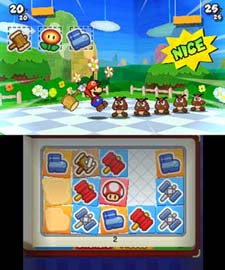
10. Paper Mario: Sticker Star (3DS)
This game got a lot of flak for not being a “traditional” RPG with experience points and a standard inventory. But if you go in with an open mind and are able to appreciate the different things that Sticker Star does to the formula – it’s almost an adventure game with battles – I think there’s a lot to enjoy. I liked its streamlined nature, broken into stages to give you a good sense of progression. Every action you take in battle is sticker-based, including basic jump and hammer attacks, and once you use a sticker, it’s gone – though there are gobs of stickers to find in the world. It’s a unique system that makes you think about what you want to use and when. The charm factor isn’t quite at the level of Paper Mario: The Thousand Year Door, but it’s there, especially in the jazzy soundtrack. Sticker Star deserves credit for daring to be different (if you want a “standard” Mario RPG, there’s plenty of Mario & Luigi games), and I look forward to trying out its successor, Color Splash, on the Wii U.
9. Resident Evil: Revelations (3DS)
I never really got into the Resident Evil series, mainly because I couldn’t get a grip on the controls before the first few zombies in the game ripped me to shreds. Somewhat ironic, I suppose, that the 3DS entry is then the version to reel me in. The aiming and shooting controls with the nub on the New 3DS work surprisingly well and feel modern enough while still being tense when multiple abominations are bearing down on you. The claustrophobic quarters of the cruise ship you’re exploring make for a great setting. The crazy story is too steeped in RE lore for me to fully grasp, but it’s fun enough, in a dumb B-movie way. Overall an enjoyable zombie-shooting experience that stands out in the 3DS library.

8. Etrian Mystery Dungeon (3DS)
While I’ve tried several roguelike games in the past, I never got really deep into them as the punishing “lose most/all of your progress when you die (and you will die), then repeat the same areas over and over” mechanic core to most of them can be pretty frustrating. However, Atlus found a way to hook me by mashing up the Mystery Dungeon series of roguelikes with the aesthetic and certain mechanics of the dungeon-crawling Etrian Odyssey games. You take a party of hand-crafted explorers into dungeons filled with myriad randomly-generated floors, items, and turn-based combat that happens directly on the overhead main screen (think Zelda, but on a grid, and when you move or take an action, the monsters get to do the same). Death is far less punishing here (and party wipes easier to avoid), and there are multiple dungeons to explore to keep up the variety. You also get the classes and character growth of Etrian Odyssey to keep driving you forward, while the dungeons and bosses provide a good challenge while mostly avoiding the YASD (Yet Another Stupid Death) cheap pitfalls of many other roguelikes. If you’re roguelike-curious, but afraid of constantly starting over after unavoidable disaster, this is a good one to try.
7. Castlevania Lords of Shadow: Mirror of Fate HD (PS3)
What a mouthful. The original version of this vampire killer came out on the 3DS, but surprisingly enough I played it on the PS3 as part of the Lords of Shadow collection. Though this game is pretty divisive, I actually ended up enjoying it more than its 3D big brother, the original Lords of Shadow. I found Mirror of Fate to be a great cross between the 2D action of classic Castlevanias (with some more modern God of War-style combat thrown in) and just enough exploration akin to the later Symphony of the Night-derived titles to satisfy that itch. I miss the classic Castlevania tunes but the dark, Gothic graphics and moody orchestral score do a good job of setting the atmosphere. The story takes a unique approach as you control 3 characters over the course of the game, and as someone who’s not attached to the original Castlevania canon, I appreciated developer MercurySteam’s different take on it. I look forward to playing their remake of Metroid 2 probably in the coming year.

6. Torment: Tides of Numenera (PC)
The first 2017 release to appear, Torment is the spiritual successor to the classic PC RPG Planescape: Torment, though it abandons the Dungeons & Dragons license of Planescape in favor of another tabletop RPG setting that takes place on Earth a billion years in the future, where countless civilizations have risen and fallen and left behind technologies that may as well be magic. Your character emerges into this world as the Last Castoff, one of numerous discarded bodies of the Changing God mysteriously granted new consciousness. You set off to explore the world, define yourself as a being, discover the motives of your sire, and ultimately decide what to do about them. True to its predecessor, there is a lot of reading in Torment – a majority of the game is spent talking to characters, asking them questions, and utilizing various skill checks to make progress. Fortunately the writing is great – though I will admit to skimming over some of it – and there are lots of interesting locations to explore and lore to uncover. Combat occasionally occurs in the form of Crises, which can play out as pretty straightforward battles but there may another way out of it through talking to characters or manipulating the environment. Combat is fairly clunky (again, like its predecessor) but also the least interesting path to take in a game that gives you a lot of options. Torment 2 probably doesn’t have as high of highs as Torment 1, but also not as low of lows, and if you complete it you can feel good about having read a novel to boot.
5. Persona Q: Shadow of the Labyrinth (3DS)
Because Japan can never get enough of a good thing, here’s a mashup of a spinoff (Persona) from a main series (Shin Megami Tensei) mixed with another series with several entries (Etrian Odyssey). Persona Q takes the characters from Personas 3 and 4, throws them together in the same universe for Reasons, and sets them off crawling through several Etrian Odyssey-style dungeon mazes, complete with your own map drawing on the 3DS touchscreen. You might think a mix of my favorite JRPGs of the past decade and my 2015 Game of the Year (Etrian Odyssey IV) might easily score higher on this list, but while I enjoyed it immensely it didn’t quite leave as strong of an impression on me as either of its inspirations. The dungeon crawling is great, with more varied designs than the average EO game, and the battles tough but fair. It was also fun to see the memorable casts of two awesome games come together and banter with each other, and the J-rock Persona-infused music is preferable to the airy, fantasy EO fare. In the end, though, the story wasn’t as good as a Persona game and I prefer the class-based growth of an EO game rather than fusing demons for the umpteenth time. Still, as a fan service game it’s top-notch and I hope that its announced follow-up, featuring characters from a certain other game on this list, makes its way to America.
4. Super Metroid (SNES)
Finally. Yes, I could’ve played this via emulation any time – and have messed around with it a bit before 2017 – but procuring a SNES Classic prompted me to at last complete probably the only landmark SNES title I had never really got into. I think I avoided it back in the 90s because, for whatever reason, I thought it was too hard or complex, and I was waaayyyyyy into RPGs and only RPGs in 1994. I have to say, I think it was a much better experience on a big TV with a Super Nintendo controller in my hand than on a computer monitor with a knockoff gamepad. I’ve dallied with other Metroid games, and love Castlevania: Symphony of the Night, but playing through Super Metroid illuminated where all that Metroidvania gameplay came from and why this is still considered the best of the best. Awesome atmosphere established by the music and visuals, tight action with a fair challenge, and addicting exploration and growth where you very rarely feel stymied (the couple of instances where you get past one barrier with a new item only to immediately run into another barrier requiring something you don’t have were frustrating). There are a couple slight control issues that I don’t think would be very acceptable in a modern game (space jumping sucks), but other than that Super Metroid really does stand the test of time and I’m glad to finally have it under my belt.

3. Fire Emblem Echoes: Shadows of Valentia (3DS)
While I enjoyed Fire Emblem Awakening, the 3DS’ first entry in Nintendo’s venerable strategy RPG franchise, it felt a little too similar to previous Fire Emblems to leave a lasting impression on me, and I really didn’t care about the romance minigames that much of the gaming internet went bananas over. Therefore I skipped the next entry, Fire Emblem Fates, but enough sounded different with Echoes, a remake of the Japan-only NES game Fire Emblem Gaiden, that I thought I’d give it a try. I’m certainly glad I did, as it now stands as my favorite Fire Emblem. The first big change is the structure. There are two main characters, Alm and Celica, and after an intro chapter with each, you get to move both around on the overworld map as you please, though they are on separate paths. However, every move you make with a character may cause enemies to spawn on one of the two paths, which may either move forward to attack or strengthen an entrenched enemy’s numbers. This adds a slight layer of high-level turn-based strategy which contributes so much to the experience – for the first time in FE you really feel like you are waging war against an encroaching army rather than moving from point to point, fighting enemies that just sit there and don’t really care what you do. Echoes also adds dungeons to the mix, which are fairly simple but a great diversion from the large scale battles, providing opportunity for third-person exploration and quick fights. There aren’t as many classes, and there’s no romance, but for me these omissions just streamline the experience to craft a truly remarkable campaign.
2. Persona 5 (PS3)
Persona fans waited 9 long years for this, but it was worth it. It’s a massive JRPG that fixes the main issue with Personas 3 and 4 – the boring, repetitive dungeons. In P5 you lead a gang of Phantom Thieves who fix the corruption in people’s hearts by diving into their psyche – crafted as elaborate dungeons each with a unique theme and mechanics – and literally battling their inner demons. And of course in the real world you’re attending school in an impressive model of real life Tokyo, making friends, answering quizzes, and working part-time jobs. The aesthetic steals the show, with stylish graphic design and funky music by series composer Shoji Meguro that easily wins Soundtrack of the Year. The cast is endearing, and the scenes where each of them awaken to their Persona powers are truly memorable. The story’s framing device of “recollecting” most of the game while being interrogated does a great job of teasing, but not quite giving away the ghost. It gets a little long in the tooth toward the end – this is a 100 hour game after all – and it’s not for everyone, but if it’s your style of game, it can’t be beat.
1. The Legend of Zelda: Breath of the Wild (Wii U)
Probably no surprise here. But let’s be clear: for me the crowning achievement of this game is that it brought together two types of games that I’ve never been completely sold on and made me fall in love with it. I’ve enjoyed 3D Zelda games, but get frustrated with the slow pace and some dungeons that are just too damn big and complex (looking at you, Twilight Princess). I’ve enjoyed open-world games, but get overwhelmed by a map filled with icons of relatively meaningless things to do, while the world manages to simultaneously feel empty. Breath of the Wild surpasses all of this to create the most memorable gaming experience I’ve had in years. It gives you all the tools and tutorials you need in the first hour of a mammoth adventure. You will explore a massive world at whatever pace you choose, and you will die, and die again – but learn from your mistakes. You’ll build your own map by spotting interesting locales from the top of a tower, than discovering them yourself. You’ll feel a constant sense of progression and reward as you come upon beautiful vistas, battle foes for new weapons and other loot, devise your own ways to solve problems that the myriad systems at work under the hood let you do, complete each of the 120 shrines that serve as the perfect bite-size mini-dungeons, and uncover the secrets of this post-apocalyptic version of Hyrule as you work your way towards the final confrontation with Calamity Ganon. The sound design, from the nostalgic theme of the shrines to the light piano riffs of overworld exploration, strikes the perfect balance between bombastic music playing everywhere in an open world game, sometimes inappropriately, and no music at all, which gets boring. From the original Legend of Zelda, to Skyrim, to Assassin’s Creed, to Dark Souls, to Monster Hunter, this game takes all of its influences and crafts them into something truly unique that is not to be missed by any gamer. I’m so satisfied knowing that Nintendo, the most important company from my childhood, can still bring its A game and give me an experience that really does make me feel like a video game-obsessed kid again.


