First, though, everybody's paychecks went down a bit this month. That sucks. But I've heard of some misinformation on Facebook, so let me explain why. In 2011 and 2012 the social security tax taken out of your paycheck was lowered from 6.2% to 4.2%, which was known as the payroll tax holiday. It was one of the provisions of a tax cut deal enacted in 2010 and extended by one year. During the fiscal cliff negotiations in December, almost all of the attention was focused on under what income level the Bush tax cuts would be extended. Hardly any politician from either party was pushing for a further extension of the payroll tax holiday, and so it expired on December 31. But that extra couple thousand bucks in your family's pockets the past couple years? Brought to you by a Democratic President and Congress. You're welcome. Unless you make more than $450K a year, your taxes are now basically the same as they were under the President That Republicans Forgot.
On a side note, it's worth mentioning that the Social Security tax is fairly regressive, in that it only affects income up to about $110,000. So, proportionally, it hits people making less than that (almost all of us) harder. Personally I would've liked to have seen a permanent lowering of the rate, replacing the lost revenue by letting the Bush cuts expire for incomes over $250K instead of $450K. I don't have the numbers to know exactly how that might work, but I think it's an idea worth exploring.
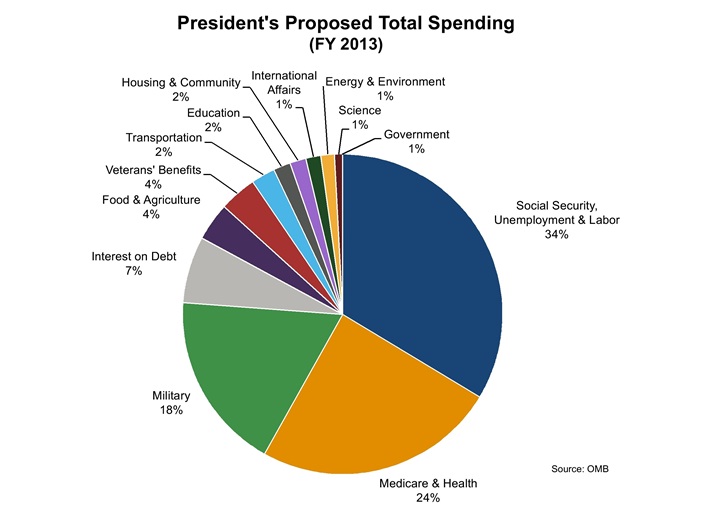
But that's a done deal for now. On to the debt ceiling. First we need to understand how the federal budget process works, at least ideally. The President, as the head of the executive branch, submits a request to Congress for all the funds necessary to keep the government running for another year, always including some funding requests for new or expanded programs that are his priorities. Congress takes that request and makes a truckload of changes to it on both the expenditure and revenue sides, inserting their own priorities as worked out (hopefully) through compromises. The finished budget is submitted to the President to sign into law, which he is required to do. Unlike many governors, he does not possess the line-item veto power, which would enable him to specifically trim parts of the budget. It's all or nothing. A vast chunk of the federal budget is composed of payments that the government is legally required to make - Social Security, Medicare, other entitlement programs, and debt interest payments - unless the law is changed as part of the budget. The budgets of government agencies - with the huge exception of Defense - are miniscule by comparison.
If the government hits the debt ceiling, one of two things would happen. One, enough cuts would have to immediately occur to balance the "expenditures = revenues" accounting formula, which would suck for millions of families across the country that receive government assistance. Two, and probably more likely, the government would default on its debt payments for the first time ever. The government's investors would suffer, our credit rating would tank, and the markets might crash. The American and global economy would be severely damaged. To quote Doc Brown, both scenarios would be some serious shit.
Let's be clear. Raising the debt ceiling has nothing to do with authorizing future spending. It has everything to do with paying the government's legally required and already incurred debts that were previously approved by Congress. It is not like raising your credit card limit. It is paying your credit card bill. There is a time and place for a debate on government spending cuts. But holding the debt ceiling hostage in exchange for equal amounts of cuts, as some Congressional Republicans are threatening to do, is ludicrous. They are not even the same issue. It's a foolhardy move that could drive the country into depression. The debt ceiling must be raised.
 So what's this trillion dollar coin about? It's a possible workaround to the debt ceiling debacle that's been proposed in some liberal circles. A law was passed in the 90s that enables the Treasury Department to mint platinum coins in any denomination. It was intended to allow Treasury to make a little money in the commemorative coin business (why let the Franklin Mint have all that sweet cash?). However, legally the President could order Treasury to mint a coin worth a trillion dollars (or some other unfathomably large amount) and deposit it. Treasury would immediately have enough funds to pay its debts until Congress returned to sanity and raised the debt ceiling, at which point the coin could be melted and we could put this sad episode behind us. Paul Krugman assures us this would have little negative macroeconomic effects, at least compared to a default, and I tend to take the Nobel-prize winning economist at his word.
Is it a bit silly? Of course. But it's a silly solution to a stupid problem that shouldn't exist. Everyone interested acknowledges it's a last-resort option. The White House has said little in support, though it hasn't explicitly ruled the coin out. Fortunately, it's looking more and more likely that it won't be necessary, as many Republican leaders are signalling they know it's a fight they will lose and don't want to take the chance of being blamed for ruining the economy. It's only the Tea Party ideologues that seem hell-bent on running the country off the rails to score a political point, and that's the surest sign yet this faction needs to be stopped.

No comments:
Post a Comment