First, since the media does such a poor job of even explaining the basics, let's make sure we have our terms straight. "Debt" refers to the total amount of money owed by the US government to its creditors. The deficit, then, is the amount by which annual expenditures exceed annual revenues, because the federal government is not required to pass a balanced budget (most states are). Having a deficit, then, adds to the total debt. Conversely, paying down the debt requires an annual budget surplus.
On a very basic level, you can compare it to a family budget, in that you have to earn more money than you spend if you want to pay off a debt, such as a credit card balance. However, common claims by conservatives that "families balance their budgets, so should the government" are grossly oversimplified and misleading. You can't really compare the actions, needs, and effects of spending by a family with a total annual budget of, say, $75,000, against the largest government and economy in the world with an annual budget of about $3.5 trillion. The former is studied by microeconomics, the latter by macroeconomics. Still, there is a simple take-away to draw from this comparison: families have to maintain a budget, but it also makes sense for them to take on debt. They use credit cards. They take on mortgages and auto loans. They get student loans for their education. Perhaps they incur short-term moving expenses in order to take a new job that will benefit them in the long run. Uncontrolled debt can ruin a family's finances, of course, but there is an appropriate time for it. Same goes with the government. (For a great takedown of this failed analogy, see this post on Daily Kos.)
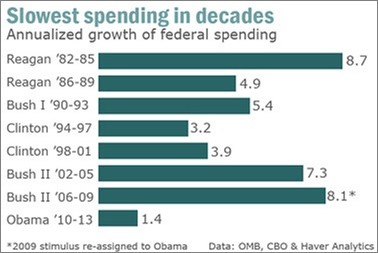
Turning to history, the last GOP president who could legitimately be called a fiscal conservative was Richard Nixon. Ronald Reagan then ushered in the Republican doctrine of "don't tax but still spend, and pass it off as responsibility." Reagan slashed taxes while increasing defense spending by astronomical amounts (see chart above), which drove up the debt. Whether such defense spending was necessary to win the Cold War is beyond the scope of this article; the point is, he had no problem cutting revenues and increasing spending at the same time by huge amounts - hardly what most people would call fiscally responsible. Later, he begrudgingly supported certain tax increases in response to lackluster revenues, which would render him persona non grata to today's slaves of Grover Norquist.
(Side note: What, you mean that the core doctrine of supply-side economics - that giving the rich more money through lower taxes will propel them to create new jobs out of the goodness of their hearts, thus stimulating enough economic activity to overcome any lost revenue, didn't quite work? You mean that the basic tenet of capitalism - that people want to make as much money as possible and will only do something that costs them (creating a job) when they are sure it is economically beneficial and necessary to do so, won out? I am shocked, shocked, I tell you!)
Then Clinton came along and, thanks to a sound economy and actual fiscal prudence, was able to completely balance the budget by the end of his administration, setting us on the course to pay off the national debt. In 2000 Presidential candidate George W. Bush responded by claiming that a budget surplus meant Americans were being overtaxed, and the Bush tax cuts were the immediate result. This begs the question - how in the holy hell are we ever supposed to pay off the debt if the moment we have a budget surplus Republicans use it as an excuse for a tax cut, thus bringing back deficit spending?
And hopefully by now you won't be surprised to learn that's exactly what happened. In 2002 Dick Cheney proudly proclaimed that "Ronald Reagan taught us that deficits don't matter." Treasury Secretary Paul O'Neill was fired after warning of a $500 billion projected deficit for 2003. To add to the structural deficit created by the tax cuts, the "war on terror" pushed the idea that the U.S. could sustain an indefinite worldwide war without requiring any meaningful financial sacrifice on the part of everyday citizens (compare that to rationing during World War II). The wars in Iraq and Afghanistan? Financed with borrowed money. They usually weren't even included in the regular budget but instead funded through supplemental appropriations. The Bush administration originally predicted the cost of the Iraq war would run about $100 billion. Now the Congressional Budget Office estimates the war will cost $1.9 trillion through 2017, with other estimates from independent economists and universities running to the $3 to $4 trillion range. But hey, the war was totally worth it, right? Got those WMDs after all.
Note that it wasn't just the wars and tax cuts - the expansion of Medicare to include prescription drug benefits was one of the biggest growths of a social program in US history. Isn't is supposed to be those dang liberals driving up deficits through government handouts? The total cost of that program is expected to be $727 billion from 2009 through 2018; however, Medicare is not allowed to negotiate with drug companies over prices like the VA is - by some estimates, allowing this could save the program at least $50 billion a year. But, you know, Congressional architect Billy Tauzin (R-LA) had to leave Congress after passage to become a Big Pharma lobbyist making seven figures, so, you know, priorities. Macroeconomists often talk about the "guns vs. butter" problem - how do governments balance military and domestic spending? Under Bush, you got guns, butter, and a cherry on top in the form of a tax cut - no problem.
The economic collapse of 2008 - the roots of which are too complex to get into here, but suffice it to say Bush economic policies contributed to it (wait, you mean the Bush tax cuts didn't create indefinite economic expansion???) - exacerbated the debt problem significantly as tax revenues fell off a cliff. However, as soon as Obama took office, the Republicans ripped off their Bush/Cheney stickers and replaced them with tricorner Tea Party hats, basically acting as if the government hadn't spent a dime before January 20, 2009. "Won't somebody think of the debt???" became the rallying cry of millions who literally months earlier had been totally OK with (or blatantly ignorant of) the immense deficit spending of the Bush administration. Meanwhile, Obama was trying to revive the economy in a way that most economists agree is sound policy - stimulus spending. The resulting picture of the federal debt looks like this:

The Obama stimulus is represented in light blue, and it never would have happened if not for the 2008 financial meltdown. But, you say, Obama has continued to spend, spend, spend! It's out of control! Well, first I would direct you to the first chart above, showing that spending growth under Obama is the slowest in decades. Here's another chart confirming the same:

Yes, that's some runaway growth there. Oh, I'm sorry, I was looking at the Bush years. Now, after the fiscal cliff deal that rang in the new year, the federal government is poised to cut its deficits by $2 trillion over the next 10 years. The large majority of this savings has come from spending cuts rather than revenue increases - $1.5 trillion for the former vs. $600 billion for the latter. Yet to hear the Tea Party talk about it, you would think the President is writing blank checks to anyone who dials him up with an Obama Phone.
This all brings me around to my main point: fiscal conservatism does not equate with fiscal responsibility. There are times to be frugal, and times to increase spending on sound programs. Clinton reduced the deficit during a robust economy. Now, we have conservatives clamoring for radical spending cuts at a time when arguably more stimulus spending is called for. Our infrastructure is in bad shape, and interest rates are currently so low that creditors are practically paying the government to borrow money from them. Why not take advantage of the situation to repair bridges and roads, invest in clean energy and the like, creating good-paying jobs in the process? Doesn't that sound financially responsible and reasonable? But no, instead we have Paul Ryan proposing budgets that drastically cut social programs and lower taxes on the wealthy, which will supposedly cause the Confidence Fairy to wave her wand and spur the economy. Meanwhile, the Dow is at record highs (so somebody must be doing well), but the median income for us middle-class schlubs is in the doldrums. And Ryan mysteriously plans to balance the budget through closing loopholes and such. How? "There's math involved, you probably wouldn't understand." Maybe Ryan really is a hipster.
Ryan's new budget, just approved by the House GOP on March 21, claims to balance the budget in 10 years. He supposedly does this despite providing $7 trillion in tax cuts to the wealthy and corporations without any plausible way to believe this lost revenue will be made up, even though he nonspecifically cuts spending to record lows. The nonpartisan Congressional Budget Office refused to give him an analysis of his budget using their own numbers because it just wasn't feasible. And he is the Very Serious Conservative Thinker, scion of fiscal responsibility. If you wouldn't base your family's budget on "well, I'm sure we'll make this up somehow," then perhaps it's time to reevaluate our opinion of the Republicans as guardian angels of the national treasure.
P.S. For a more balanced approach to budgeting, please check out the plan put forth by House Democrats, which combines a mixture of spending cuts and new revenues to reduce the deficit by $1.7 trillion while still providing for some stimulus spending. It's rather similar to the mixed plan that Very Serious Centrists and DC Pundits seem to want, and yet when anyone points this out to them, their only response is that Obama needs to LEAD HARDER to get Republicans to come around to positions they regard as anathema. Sigh.

No comments:
Post a Comment