| The Kansas wheat harvest |
(Disclaimer: Though I'll do my best to get all my facts straight, I'm not an expert on these issues. I encourage you to do more research if you're interested.)
Chronic Drought and the Disappearing Aquifers
From 1988 to 1995 my family lived in Hays, a town of about 20,000 in west-central Kansas whose primary reason for existence - in the post-rail and post-oil boom era - is to serve the needs of the farming towns around it through its retail outlets, medical facilities, and state university. It's a nice town with a lot of rich history, from Wild West luminaries like Wild Bill Hickok and Buffalo Bill Cody, to the arrival of the Volga Germans from Russia who brought polka, Oktoberfest, and bierocks (meat and cabbage-filled buns) to town.
 |
| The Ogallala / High Plains Aquifer |
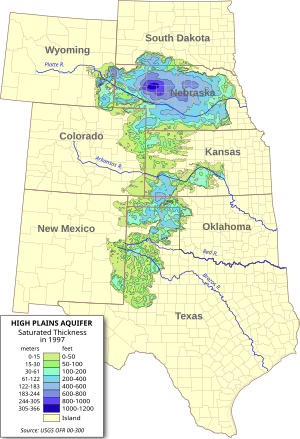
This piece from the New York Times explains the current situation on the Plains and was the major inspiration for this post. Essentially, chronic drought and farming of water-intensive crops such as corn threaten to render irrigation from the aquifer impossible from Kansas southward. Even if the drought ended and the region received sufficient rainfall to begin refilling the aquifer, it would take hundreds of years to be meaningful. Kansas agriculture would likely survive a future without irrigation from the aquifer, but the damage to both crop yields and farmers' incomes would be real and serious. Combined with other societal and economic pressures on the Plains (an aging population, lack of opportunities for young people, lack of access to amenities available in larger cities), and in the coming decades abandoned farms and small ghost towns may become a common sight in western Kansas.
What or who is responsible for this situation? As with any complex issue, there are a variety of factors. The increasing demand and price for corn is a big one. Corn is very thirsty and as such is naturally unsuited to be raised on the High Plains. After all, when you think of the Corn Belt, states like Nebraska, Iowa, and Illinois come to mind - not Kansas. But a high price for corn, driven partly by the demand (and government mandate) for ethanol, has prompted farmers in arid areas to grow more and more corn - and I really can't blame them for going where the profits are. If anything, it reveals the long-term issues with biofuels as a source of green energy. Of course, America's unending demand for highly processed foods with copious amounts of corn syrup is also a price driver. As the ability to irrigate corn dwindles, however, many farmers will be forced to make the switch to less water-intensive crops, such as milo and sorghum.
What about global warming? Did that cause the drought? The verdict's still out on that one. A report issued by the National Oceanic and Atmospheric Administration didn't want to pin much blame on climate change for the 2012 drought, though some scientists claim the report was flawed and ignored several important factors (and different media outlets seem to have drawn different conclusions from the same report). Many farmers do seem to agree that the climate is changing - and not for the better - they might just be unwilling to finger man-made global warming as the culprit due to the rampant politicization of the issue. Despite 97% of scientists agreeing that the global climate is warming due to human activities, the rabid opposition by conservative leaders to any policies designed to curb this warming - opposition often rooted in groundless conspiracy theories - will impede any efforts to alleviate the situation. Many Republicans used to support market-based solutions to climate change such as a cap-and-trade system, whereby "clean" polluters could sell their extra carbon allowances to dirtier outfits. Not since the rise of the Tea Party. Now it's deny, deny, deny.
 |
| Let's not repeat this. |
As part of the New Deal, the FDR administration responded aggressively to the Dust Bowl. The Soil Erosion Service (today the Natural Resources Conservation Service) was established within 100 days of Roosevelt taking office. The government bought up cattle in many areas for better than market price, which helped many farmers, who couldn't afford to keep them, avoid bankruptcy. The Civilian Conservation Corps planted more than 200 million trees from Canada to Texas to break the wind and hold topsoil in place. Farmers were educated on cultivation techniques that better preserved the soil, and were paid $1 an acre to try these methods out. Were these efforts appreciated? Well, Kansas' solidly Republican voters contributed to FDR's landslide reelection in 1936, even preferring him to native son Alf Landon (himself considered a liberal Republican in his day, who accepted much of the New Deal). But can you imagine any of these programs making it through Congress today? Socialism!!!
And that's what concerns me, should another truly severe crisis occur. I have the most faith in the farmers of the Plains to be stewards of the land. After all, their lifeblood depends on it, and many of them are outstanding environmentalists. I have my doubts, though, about a Kansas state government completely controlled by Governor Brownback and the Tea Party to respond effectively to such a disaster. When your policy positions are based on the core tenets of 1) environmental regulations destroy businesses, 2) government assistance to those in need is almost always wasteful, and 3) climate change is a hoax spread by Al Gore and the UN, I have little confidence that you'll coordinate an effective response. One of Brownback's top agricultural priorities was to erase almost all restrictions on corporate farm ownership in Kansas. Fortunately, that bill stalled due to bipartisan opposition. Allowing corporations like Monsanto unfettered access to Kansas farmland would not only likely crowd out (or buy out) family farmers, but it's easy to contemplate the environmental impacts of megafarms that can afford to do whatever they want to the land within the bounds of whatever regulations are left.
In my next entry in this series, I'll be diving into corporate farming in more detail, as I explore the world of Monsanto and genetically modified crops. What might be the effects of changing how humans have practiced agriculture for 6,000 years? That and more in my next entry on the future of farming.

No comments:
Post a Comment