Anyone interested in proselytizing hobby board games has a stable of "gateway games" that they use to spread the good word to receptive newbies. Such games need to be fairly simple, attractive, and fun, while presenting the option to go deeper if the fledgling gamer desires. There are a few standard-bearing gateways - Settlers of Catan, Ticket to Ride, and Carcassonne (the first two are now available even at Target). Those are all great games, but in my opinion, overexposure has rendered them somewhat blase. So I'd like to present five other gateway games that are staples of my collection but not quite so omnipresent in the gaming world. Each one introduces a genre of hobby gaming that has many more titles to choose from, if the intro game really grabs your attention. Plus I've thrown in a sixth bonus game that is not a gateway game, but a true classic that should be played by anyone ready for the next step. All of these games are available on Amazon for decent prices, and provide hours of fun for families and game groups alike.
 |
| Acquire. Hey, looks aren't everything. |
The 1962 classic from Sid Sackson is still the best intro-level economic game. Players draw tiles and place them on a board to form hotel chains. They can then buy shares of stock in those chains, which increase in value as the chain's size grows. If two chains grow together on the board, the smaller chain is acquired by the larger one, with payouts for shareholders of the smaller chain. But the biggest rewards come from having lots of shares in the large chains that are left on the board at the end of the game. The game teaches you ideas of cost/benefit analysis, wise investment decisions, and money management as you must carefully try to receive payouts from mergers during the game (as this is your only source of income), while also being heavily invested in the remaining large hotels. These basics of running an economic engine can be applied to countless other economic games. Some of my other favorites are Airlines: Europe, Railways of the World, and Power Grid, my all-time favorite game.
 |
| On the Underground |
Route-Building Games: On the Underground
Ticket to Ride is most everybody's first route-building game. It's fine, but I'm going to go with the London Tube instead. In On the Underground players use their own pieces to build routes along the subway. They get immediate points for connecting certain spaces on the board, and also score points when the World's Laziest Passenger travels on one of their routes (he will do anything to avoid walking). Players must carefully balance these two ways of acquiring points, as they are often at odds. Its advantage over TtR is that you can build anywhere on the board you want, rather than having to collect sets of colored cards first. That makes it more strategic while keeping the gameplay simple. Thurn and Taxis is another great entry-level route-building game, while this mechanic also gets wrapped into part of more complex games, like the aforementioned Railways of the World.
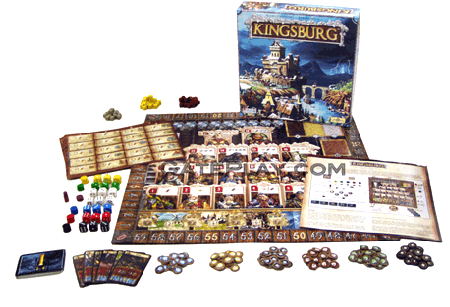 |
| Kingsburg |
Worker Placement Games: Kingsburg
Worker placement is a very common mechanic in euro-style games. It basically means "players each have a limited number of dudes to place on a limited number of board spaces to get stuff." These games can get really complex, and I tend to avoid the heaviest ones where you have to go through about 5 steps before actually scoring points. Kingsburg, however, greatly simplifies this process and adds the excitement of rolling dice, which are basically your "workers." Based on what you roll, you place your dice on different "advisor" spaces which gets you things like building materials and soldiers for your army. Then you get points by building structures and fighting off the baddies that attack the kingdom at the end of every year. It requires a careful but accessible balance of short-term reactions ("here is what I rolled...crap he took the spot I wanted") and long-term strategic planning ('I want to work towards building the cathedral"). Other worker placement games I've enjoyed include Alien Frontiers (which also uses dice), Stone Age, and Tribune.
 |
| Flash Point: Fire Rescue |
Cooperative Games: Flash Point: Fire Rescue
Many non-gamers are probably unaware there exists an entire genre of board games that require the players to work together to defeat the game. Great co-op games instill a great sense of camaraderie and tension as players try to achieve a seemingly impossible goal. (Good co-ops are also hard, as they would get old quickly if the players always won.) Pandemic and its simpler cousin Forbidden Island tend to be the poster children for intro co-ops, but I'm going to pick the lesser known Flash Point as my recommendation. As you might expect, in this game players are a team of firefighters trying to rescue victims from a burning building. You can do things like chop down walls, drive the truck and ambulance, and fire the deck gun. It requires a great amount of planning and communication among the players. Best of all, the rules are incredibly adjustable, which allows for a very easy game that kids can play or a brain-buster that any gamer can get into. Once you've cut your teeth on these pure cooperative games, you can graduate to Shadows Over Camelot, which adds the possibility of a secret traitor in the players' midst.
| Small World |
Area Control Games: Small World
What's an area control game? Just think of Risk. You score points by having pieces in certain areas of the board, and usually take over new areas by fighting other players' pieces. Most war games are such. Small World, though, is what I call a "euro war" game, in that it is heavily influenced by other European board games and features diceless, deterministic combat. Players pick a race such as Halfings, Orcs, Humans, or Dwarves, which also has some special ability paired with it. They then use the tokens of that race to take over as many areas of the board as possible, and can defeat other players simply by overwhelming them with more tokens. Eventually, though, that race will be overextended, and you'll have to put them in decline and start over with a new race (the decision of when to do this is the most important you'll make in the game). The random pairing of races and special abilities in every game really adds to the replayability, and the simplicity of the combat rules makes it very accessible. Along with economic games, area control games are my favorite genre, which is why I'm going to highlight one more...
 |
| El Grande |
Bonus! El Grande - The Next Step in Area Control
El Grande is my #2 overall favorite game. It was the first great Euro-style area control game, and is still arguably the best. If you want to split hairs, El Grande is technically an "area majority" game, because you score points simply by having the most pieces in an area, rather than kicking other players out. You try to score as many points as possible by placing pieces in different areas of Spain and trying to have more pieces in each area (you also score points for placing 2nd and 3rd). There are devious ways to mess with other players' pieces, and a tower you can place hidden pieces in to be distributed on the board later. Gamesmanship is very high in this one, and the elegance with which is plays out renders it one of the all-time greats. It's not a gateway game, but if you can play Risk, you can play El Grande. In my humble opinion, it sits at the pinnacle of board game design.

No comments:
Post a Comment