Friday, March 29, 2013

The War on Easter: A Veteran's Tale

(Note: Hopefully this goes without saying, but the following is a work of satire.)

Those were heady days.  I had served admirably in the Christmas War of 2012.  The beards of five mall Santas decorated the walls of my man cave.  Sadly, two of them were fake.  My stealthy ability to use garland to choke anyone who uttered "Merry Christmas" got noticed by the brass.  Not only did I receive two Medals of Marx, they even gave me December 25 off.  On a grand scale, the enemy's attempt to extend Christmas by opening stores on Thanksgiving had backfired, destroying that holiday as well.  Now it was all just forty days of Secular Humanist Capitalist Consumption Season.  Life was good.

Our mission was far from complete, however.  In early February the O-bot chip implanted in my brain activated, signalling that I had a new message from Dear Leader.  My services would again be needed.  He appeared in my mind's eye wearing a dark brown hooded robe, as was his custom.  "Loyal followers," he intoned, "I must call you to action once more.  Immediately following February Platonic Friendship Day, those who would destroy our way of life will begin preparation for a holiday called Easter.  As a Muslim Atheist, I'm not aware of the specifics of this celebration.  However, my bros in Friends of Hamas tell me that stores will be soon be filled with rabbits, eggs, and barely edible things called "Peeps" that are somehow vaguely associated with the religion of the enemy.  We cannot allow this!  Rabbits don't have eggs!  And I will have no references to the Anglo-Saxon goddess Eostre in the land of the New Black Panther Muslim Brotherhood!  Agenda 21 dictates that Easter must be eradicated!"

"Yes, my lord," I obediently replied.  Detailed instructions for my role in this struggle followed.  I was the captain of an elite task force known as the Soetoro Squad.  Our mission was to infiltrate school districts and ensure that any references to "Easter" were replaced with "Spring."  Thus "spring recess" and "spring egg hunts" were held from Alaska to Alabama.  The mind-control powers bestowed on us by the Great One made this task particularly easy.  We would zoom in riding our black helicopters, work our magic, and quickly be dispatched to the next location.

Eventually, though, we began to meet resistance.  Organizations such as O'Reilly's Rebels and the Dukes of Doocy caught on to our ingenious scheme.  Not content with broadcasting their filth from the Iron Throne atop Rockefeller Plaza, they mounted an armed insurgency.  The War on Easter had begun.

The enemy.  Bring it.
Fortunately, the Great One had naturally anticipated violence, and thus had ordered the Department of Homeland Security to buy up all the ammo on the market, leaving the rebels only the stockpiles they already had on hand.  This was only ten times the amount the army had, and thus it became a war of attrition.  Skirmishes between the O-Bots and the "Bunnies," as we came to call them, flared up all over the country.  Slowly but surely we drove the enemy back.  Prisoners were sent to FEMA's shiny new concentration camps, where they were reeducated into proper Secular Progressive Socialists.  The front receded deeper and deeper into Holy Texas, until it became clear the final battle would take place at a mighty bastion called Independence, commanded by a figure shrouded in mystery, known only as The Beck.

I was there.  The Battle of Independence raged for three full days.  I led my squad in a daring raid to take out Doocy, one of The Beck's top lieutenants.  By that time, ammo was running short for the Bunnies, so they were getting creative with their tactics.  Several gruesome casualties on my squad resulted.  Krugman ate it when an egg land mine exploded under him, sending deficit-funded shrapnel into his luscious beard.  Biden got caught in a web of some sort of fake grass and we had to leave him behind; after the fortress fell he was found bound and gagged in a room with Paul Ryan, Marco Rubio, and a bottle of water.  I shudder at the torture he endured.

I was left alone to confront Doocy, whom I found going over the latest transcript he had been handed from the Throne and audibly complaining it didn't make him sound smarmy enough.  We shared a homeland, Doocy and I, and I was eager to wipe that shit-eating smirk off his face once and for all.  I caught him off guard, and he attempted to woo me with the same charm he used to manipulate millions of Bunny underlings.

"Hey, man, all we wanna do is wish each other Happy Easter," he pleaded.

My rage at hearing the E-word knew no bounds.  I knew the time for talk was over.  Being a liberal, I had of course never fired my gun.  I put my finger on the mechanism I felt pretty sure was the trigger and pulled it.  Doocy's head exploded in a shower of blood so epic I felt as empowered as Tarantino's Django.

I looked at what was left of the corpse.  "Happy Spring, you freedom-loving asshole."

The Great One ultimately defeated The Beck in an epic duel atop Mount Galt.  The War on Easter was over, with the righteous forces of Secular Humanism once again victorious.  The holiday once known as Easter is now called the Spring Anti-Fertility Observance.  Gay Scout leaders hand out plastic eggs filled with condoms and birth control pills to all the little boys and girls.  Once again, everything is right with the One World.

I love the smile on Dear Leader's face just as the knife goes into that rabbit's back.  Booyah!

Wednesday, March 27, 2013

Marriage Equality: The Tide of History


"If love is the only measure, then the only measure of love is love without measure." - St. Augustine

Marriage equality is coming.  It is inevitable.  It may not happen nationwide this year before the Supreme Court, but it will happen eventually.  There has been an unmistakable generational shift on the issue that reaches across political and religious boundaries, and once that age cohort is running the show, gay marriage will be as obsolete of an issue as interracial marriage.

(Note: I know "marriage equality" is the more PC term, but for brevity's sake I'll often refer to it as "gay marriage."  We all know what we're talking about here).

I know what it’s like to wonder if you’ll never be able to get married.  I’ve been there.  For me, thankfully, it came through.  Of course, some people never choose to marry, and that’s fine too.  But it should be an option, and I can’t imagine being told that the government forbids me to marry the person I love.  This is why I fully support the right of gays and lesbians to marry whomever they choose.

It is obvious that the course of history bends toward marriage equality.  The most virulent opponents of gay marriage are going to, frankly, die off, and polls show that 80% of people under 30 support marriage equality.  That's not likely to change anytime soon, and those people will only get older.  I credit the Millennials' acceptance of gay marriage to modern communication making interaction with gay people and the gay community easier than ever before.  As people learn through first-hand experience that gays and lesbians are not the societal outcasts "traditional" culture has made them out to be, it becomes natural to believe that they should have the same marriage rights as anyone else.

I understand that for many people, especially in rural America, the overwhelming trend toward marriage equality can be a bit discomforting.  Perhaps they've never met an openly gay person.  They have allowed the bigotry spread by right wing media - which has a lot more penetration in middle America than Out Magazine - to affect their attitudes, even if only on a subconscious level.  This is why gay marriage advocates need to honestly and kindly combat negative images through their own media efforts.  Eventually this will likely not be necessary, but as marriage equality continues to meet strong resistance in many parts of the country, a continuous outreach effort will be needed.

Larrry Duncan and Randy Shepherd
 Pretty sure these dudes could beat me up.  Please, get married.
For example, here are Larry and Randy.  They were one of the first couples to get married in Washington state when gay marriage went into effect there on January 1, 2013.  They're not exactly the flamboyant young party animal stereotype, are they?  They're normal dudes.  They look like they could be my dad's hunting buddies.  All they want is to love each other and have the legal recognition of such.  Who are we to deny that?  To all you libertarian types out there - who is the government to deny that?  Either embrace your small-government beliefs, or quit pretending.

Such images are moving, and will only be enhanced as the gay community and its allies can effectively introduce themselves to the heartland.  I'm from there, I know they're good people, and I maintain my belief that they can be more accepting if the hate can be met with love and personal exposure.  The power of personal knowledge and awareness is undeniable.  Even Republicans such as Dick Cheney and Rob Portman have expressed support for equality after one of their family members came out. And if Cheney and I can agree on something, it must have some merit.

For the second half of this post, then, I'll address what I see as the most common arguments against marriage equality.  There's some tough love for opponents in here, but it needs to be said.  In 20 years these arguments will be outright ridiculed and automatically dismissed; at least I'm taking the time to explain their flaws.

1. Gay marriage is against God's will.

You are free to believe what you want to believe.  However, it doesn't matter.  Sorry if that sounds blunt but it's true.  There's a reason why there were zero religious-based arguments brought before the Supreme Court.  They have no place in American jurisprudence.  Religious freedom means we celebrate a diversity of belief.  It does not mean the freedom to impose religious views on the majority who disagree with you on an issue that fundamentally has nothing to do with religion.  Moreover, no gay marriage law to date has forced churches to perform gay weddings that they are opposed to, and that's not going to change.

However, the Christian Right is clutching their pearls over the mythical Christian persecution that I've blogged about before.  They somehow believe that a country where 95% of religious people identify as Christian (and 80% of the Congress) will systematically destroy Christianity if gay marriage is allowed.  I'm not exaggerating.  Frequent Fox News contributor Erick Erickson: "Within a year or two we will see Christian schools attacked for refusing to admit students whose parents are gay. We will see churches suffer the loss of their tax exempt status for refusing to hold gay weddings. We will see private businesses shut down because they refuse to treat as legitimate that which perverts God’s own established plan."  In other words, because of perceived fear of discrimination against straight Christians, he wants a black check to be able to discriminate against gay people.  Disgusting.

Fortunately, many Christians have embraced equality and refuse to let fear of diversity get in the way of spreading the message that God loves all of us and wants us to be happy so long as we respect Him and each other.  I have hope that they will soon become the vocal majority of Christians.  My favorite is this clever minister, who turns the words of racial bigotry into a powerful argument for marriage equality:


2.  Gay marriage goes against "traditional" marriage.

This is closely related to the first argument, as most proponents' idea of "traditional marriage" falls neatly in line with the modern American Christian ideal.  However, the concept of marriage has evolved greatly through human history and around the globe.  For much of history and in many cultures, marriage was merely a business or political transaction.  Marriages were prearranged from birth.  In some cultures polygamy and harems were widely accepted practices.  In many, you were not allowed to marry for love.  You were not allowed to marry outside your social class.  You were not allowed to marry outside your religion.   You were not allowed to marry outside your race.  All these practices have been defended as "traditional marriage," and all have lost.  We may be heading into uncharted territory by recognizing gay marriage as valid, but gay people have been around as long as straight people.  If we finally acknowledge that they can marry whom they love as much as anyone else, I think that's an expansion of "traditional marriage" that we can be proud of.

Tied into this is the idea that gay marriage somehow devalues or damages straight marriage.  I'm not exactly sure how this works.  Apparently our straight marriages are so fragile that seeing gay people get married will lead to their destruction (never mind that half of straight marriages end in divorce anyway).  Gay marriage is already legal in ten states, and I'm pretty sure society isn't crumbling there.  The attorney arguing against gay marriage in the Supreme Court - hopefully a leading expert on the issue - could not come up with a single reason why gay marriage harms straight marriage.  That's because there isn't one.

3.  If we allow gay marriage, what will be next?  Polygamy?  Marrying children?  Marrying dogs?  Marrying toasters?

This is the lamest, most offensive snowball-fallacy argument I have ever heard.  It's so weak it almost feels like something marriage equality supporters would put forth as a straw-man argument because it's so easy to knock down.  And yet Rush Limbaugh made the "gay marriage leads to pedophilia" claim just the other day.  What's to stop marriage/sex with a child?  Oh, I don't know, how about the law and the age of consent?  Marriage is between consenting adults.  If we allow gay marriage, will an arsonist set fire to your house?  Because that has about as much to do with gay marriage as pedophilia does.  To claim otherwise is insulting and demeaning to every gay person on earth.  We better ban straight marriage too then, because there's certainly a lot of opposite-sex pedophilia going on as well.  That some people take the argument further into "dog and toaster" territory is laughable.  Please, please try telling a gay person that the love they have for their partner is roughly equivalent to the love for a pet or inanimate object.  Would you ever say that to a straight person?

Polygamy is a separate issue that needs to be worked out on its own merits and divorced from gay marriage.  You can certainly argue that consenting adults should be able to organize their families as they wish.  However, whereas being gay is not a choice, polygamy is, and recognizing it would open up all sorts of legal issues regarding spousal benefits and such.  It's an issue certainly worth discussing, but it's completely separate from the issue at hand.

4.  Marriage is defined by natural procreation, and gay people should not be parents.

A double-whammy here.  First, are we going to tell all the infertile straight couples that their marriage is invalid?  What about straight married couples who choose not to have children?  Older folks who get married past child-rearing age?  We have never prevented them from being married.  So obviously we cannot hold natural procreation as the basis for a marriage definition.

The second part of this argument involves a bit of concern trolling, in that opponents claim to be worried about the effects gay parents, or the lack of both a mother and father, have on children.  While I agree that ideally a child should have strong role models of both genders in their lives, there is no guarantee that their parents will be such.  Maybe the dad is abusive or in prison.  Maybe the mom is an alcoholic or watches TV all day.  Is such a situation really better than having two loving, doting fathers or mothers?  Don't conservatives want kids to grow up in strong, married families?  (Oh, but only the kind of marriage they approve of, I see.)  I taught in a school with a lot of broken families.  Hardly anybody came to parent-teacher conferences.  I would have gladly welcomed two moms or dads coming into my classroom to talk about their child. 

Additionally, as Justice Kennedy (not a flaming liberal) noted, there is legitimate cause for concern over the detrimental effects denying gay marriage has on gay couples' children.  They are indirect beneficiaries of the benefits denied to gay couples that straight married couples enjoy - inheritance, tax breaks, medical benefits, etc.  Is it fair to deny kids such just because of who their parents are?  Not to mention the social issues these children face due to the stigma that comes with having same-sex parents.  Not that making gay marriage legal will solve that issue overnight, but recognizing their marriage as valid will at least set us on the right track.

In that vein, I'd like to close with the words of a brave sixth-grader advocating for his parents' right to marry in Rhode Island.  Cynical opponents of marriage equality would argue that he's being manipulated and put up to it.  Personally I think he's a smart kid who just wants there to be a little more love in the world, and there's nothing wrong with that.


Tuesday, March 26, 2013

Fox News Treats Its Viewers Like Idiots

There is so much to write about the propaganda machine that is Fox News, and I've touched on some of it before.  But what bothers me the most, probably, is their blatant abuse of graphics to present misleading or outright false information.  They cynically play on their viewers' assumptions that shiny maps and charts must be displaying Gospel Truth and thereby get away with spreading some of the basest right-wing filth I've seen in major media.  They really like to do it with regards to President Obama's record on unemployment and the economy, as these can be complex issues that a flashy graphic distills into one inaccurate statistic (go here for a thorough history and explanations).

Today, though, they presented what I found to be the most offensive graphic yet.  In support of the standard right-wing talking point that "one cold snap proves climate change doesn't exist," Neil Cavuto presented this map to his audience:


Now, do you notice anything about these two maps?  What's missing?  Oh, I don't know, how about some freaking numbers?  A map key, perhaps?  Just what are we looking at here?  There is no way to know.  All we know is that the map on the left looks REALLY HOT and the map on the right looks REALLY COLD and since it's more recent, climate change/global warming is a hoax!  QED!  But these maps could have been filled in by a kid with a coloring book, for all the actual information they present.

Now why do you suppose any sort of actual data was left off?  Because if it were there it would be obvious Fox is full of crap.  But before I provide what Fox did not, take a look at the maps and try to figure out what they show.  It would be reasonable to assume that they depict average temperatures of some kind.  On the right, using the colors that we most commonly associate with temperature maps, it looks like it's the coldest in the Upper Midwest and northern Great Plains, and warmest in the South.  That's reasonable.  But now apply that same logic and scale to the map on the left.  Look at all those warm colors.  Where is the most blazing hot heat?  Wisconsin?  Michigan's Upper Peninsula?  Meanwhile LA appears to be undergoing some sort of frost.  Does that make any sort of sense for an average temperature map for the US in March?  Of course not.  These two maps aren't even comparing the same thing.

http://www.ncdc.noaa.gov/sotc/service/national/Divisionaltrank/201203-201203.gif?opt=final

Here is the actual left map.  Notice how it has things such as a descriptive title and clearly defined key?  How informative!  It shows whether temperatures in an area were above or below average during March 2012.  So the Midwest was above average while the West Coast was below average, and so the differences in "hotness" make sense on such a map.  In fact, taken on its own this map actually makes the case for global warming, because it shows that in March 2012 temperatures in a rather large part of the country were warmer than in the past.

Click Image For MAX/MIN Station Plots

The map on the right here equates with Fox's right-side map above.  It shows the minimum temperature for ONE DAY - March 20, 2013.  That explains why the colors are what we'd expect them to be.  But Fox commits the cardinal sin of statistics - it compares averages to one data point in a way that is dishonest, misleading, and doesn't even make sense.  It's basically like telling a bowler with a 100-game average of 240, "Hey, one time I bowled a 250, so I'm obviously better than you."  You cannot disprove long-term trends with one outlying data point (and with the maps, Fox isn't even doing that honestly).  This is Scientific Analysis 101, but as the right wing has shown time and time again, they have no regard for such lofty ideas.

There is a word for such blatant misrepresentation of data: propaganda.  There is no other explanation.  They have done it so many times that sheer incompetence can't explain it.  As I've said before, I would have no problem with Fox if they were merely a conservative-leaning network.  But they are not.  They are a vile, puking automaton that regurgitates the detritus fed to them by their right-wing overlords in order to dupe their viewers into believing they provide "fair and balanced" coverage.  Please, do not get your "information" from them.

As a final note, here's a lovely graph that shows the difference in how the same set of data can be selectively interpreted to fit your talking points.   It uses 40 years of data, however, so I'm sure it's totally useless.

Thursday, March 21, 2013

The Myth of GOP Fiscal Conservatism and Responsibility

One of the biggest pieces of misinformation that conservatives like to throw around, which is aided and abetted by the supposedly "liberal" mainstream media, is that choices on economic policy boil down to "fiscally conservative" Republicans vs. "tax and spend" Democrats.  The record of the past 30 years blows this claim out of the water to such a degree that it is downright shameful that the GOP still gets away with it.  Now, I'm not saying that there is never a time to be fiscally conservative.  However, the perception of the Republicans as the Golden Knights of Austerity and Fiscal Prudence really needs to be dismissed.

First, since the media does such a poor job of even explaining the basics, let's make sure we have our terms straight.  "Debt" refers to the total amount of money owed by the US government to its creditors.  The deficit, then, is the amount by which annual expenditures exceed annual revenues, because the federal government is not required to pass a balanced budget (most states are).  Having a deficit, then, adds to the total debt.  Conversely, paying down the debt requires an annual budget surplus.

On a very basic level, you can compare it to a family budget, in that you have to earn more money than you spend if you want to pay off a debt, such as a credit card balance.  However, common claims by conservatives that "families balance their budgets, so should the government" are grossly oversimplified and misleading.  You can't really compare the actions, needs, and effects of spending by a family with a total annual budget of, say, $75,000, against the largest government and economy in the world with an annual budget of about $3.5 trillion.  The former is studied by microeconomics, the latter by macroeconomics.  Still, there is a simple take-away to draw from this comparison: families have to maintain a budget, but it also makes sense for them to take on debt.  They use credit cards.  They take on mortgages and auto loans.  They get student loans for their education.  Perhaps they incur short-term moving expenses in order to take a new job that will benefit them in the long run.  Uncontrolled debt can ruin a family's finances, of course, but there is an appropriate time for it.  Same goes with the government.  (For a great takedown of this failed analogy, see this post on Daily Kos.)
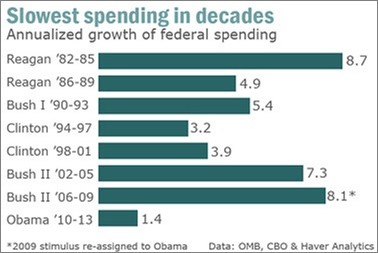


Turning to history, the last GOP president who could legitimately be called a fiscal conservative was Richard Nixon.  Ronald Reagan then ushered in the Republican doctrine of "don't tax but still spend, and pass it off as responsibility."  Reagan slashed taxes while increasing defense spending by astronomical amounts (see chart above), which drove up the debt.  Whether such defense spending was necessary to win the Cold War is beyond the scope of this article; the point is, he had no problem cutting revenues and increasing spending at the same time by huge amounts - hardly what most people would call fiscally responsible.  Later, he begrudgingly supported certain tax increases in response to lackluster revenues, which would render him persona non grata to today's slaves of Grover Norquist.

(Side note: What, you mean that the core doctrine of supply-side economics - that giving the rich more money through lower taxes will propel them to create new jobs out of the goodness of their hearts, thus stimulating enough economic activity to overcome any lost revenue, didn't quite work?  You mean that the basic tenet of capitalism - that people want to make as much money as possible and will only do something that costs them (creating a job) when they are sure it is economically beneficial and necessary to do so, won out?  I am shocked, shocked, I tell you!)

Then Clinton came along and, thanks to a sound economy and actual fiscal prudence, was able to completely balance the budget by the end of his administration, setting us on the course to pay off the national debt.  In 2000 Presidential candidate George W. Bush responded by claiming that a budget surplus meant Americans were being overtaxed, and the Bush tax cuts were the immediate result.  This begs the question - how in the holy hell are we ever supposed to pay off the debt if the moment we have a budget surplus Republicans use it as an excuse for a tax cut, thus bringing back deficit spending?

And hopefully by now you won't be surprised to learn that's exactly what happened.  In 2002 Dick Cheney proudly proclaimed that "Ronald Reagan taught us that deficits don't matter."  Treasury Secretary Paul O'Neill was fired after warning of a $500 billion projected deficit for 2003.  To add to the structural deficit created by the tax cuts, the "war on terror" pushed the idea that the U.S. could sustain an indefinite worldwide war without requiring any meaningful financial sacrifice on the part of everyday citizens (compare that to rationing during World War II).  The wars in Iraq and Afghanistan?  Financed with borrowed money.  They usually weren't even included in the regular budget but instead funded through supplemental appropriations.  The Bush administration originally predicted the cost of the Iraq war would run about $100 billion.  Now the Congressional Budget Office estimates the war will cost $1.9 trillion through 2017, with other estimates from independent economists and universities running to the $3 to $4 trillion range.  But hey, the war was totally worth it, right?  Got those WMDs after all.

Note that it wasn't just the wars and tax cuts - the expansion of Medicare to include prescription drug benefits was one of the biggest growths of a social program in US history.  Isn't is supposed to be those dang liberals driving up deficits through government handouts?  The total cost of that program is expected to be $727 billion from 2009 through 2018; however, Medicare is not allowed to negotiate with drug companies over prices like the VA is - by some estimates, allowing this could save the program at least $50 billion a year.  But, you know, Congressional architect Billy Tauzin (R-LA) had to leave Congress after passage to become a Big Pharma lobbyist making seven figures, so, you know, priorities.  Macroeconomists often talk about the "guns vs. butter" problem - how do governments balance military and domestic spending?  Under Bush, you got guns, butter, and a cherry on top in the form of a tax cut - no problem.

The economic collapse of 2008 - the roots of which are too complex to get into here, but suffice it to say Bush economic policies contributed to it (wait, you mean the Bush tax cuts didn't create indefinite economic expansion???) - exacerbated the debt problem significantly as tax revenues fell off a cliff.  However, as soon as Obama took office, the Republicans ripped off their Bush/Cheney stickers and replaced them with tricorner Tea Party hats, basically acting as if the government hadn't spent a dime before January 20, 2009.  "Won't somebody think of the debt???"  became the rallying cry of millions who literally months earlier had been totally OK with (or blatantly ignorant of) the immense deficit spending of the Bush administration.  Meanwhile, Obama was trying to revive the economy in a way that most economists agree is sound policy - stimulus spending.  The resulting picture of the federal debt looks like this:


The Obama stimulus is represented in light blue, and it never would have happened if not for the 2008 financial meltdown.   But, you say, Obama has continued to spend, spend, spend!  It's out of control!  Well, first I would direct you to the first chart above, showing that spending growth under Obama is the slowest in decades.  Here's another chart confirming the same:


Yes, that's some runaway growth there.  Oh, I'm sorry, I was looking at the Bush years.  Now, after the fiscal cliff deal that rang in the new year, the federal government is poised to cut its deficits by $2 trillion over the next 10 years.  The large majority of this savings has come from spending cuts rather than revenue increases - $1.5 trillion for the former vs. $600 billion for the latter.  Yet to hear the Tea Party talk about it, you would think the President is writing blank checks to anyone who dials him up with an Obama Phone.

This all brings me around to my main point: fiscal conservatism does not equate with fiscal responsibility.  There are times to be frugal, and times to increase spending on sound programs.  Clinton reduced the deficit during a robust economy.  Now, we have conservatives clamoring for radical spending cuts at a time when arguably more stimulus spending is called for.  Our infrastructure is in bad shape, and interest rates are currently so low that creditors are practically paying the government to borrow money from them.  Why not take advantage of the situation to repair bridges and roads, invest in clean energy and the like, creating good-paying jobs in the process?  Doesn't that sound financially responsible and reasonable?  But no, instead we have Paul Ryan proposing budgets that drastically cut social programs and lower taxes on the wealthy, which will supposedly cause the Confidence Fairy to wave her wand and spur the economy.  Meanwhile, the Dow is at record highs (so somebody must be doing well), but the median income for us middle-class schlubs is in the doldrums.  And Ryan mysteriously plans to balance the budget through closing loopholes and such.  How?  "There's math involved, you probably wouldn't understand."  Maybe Ryan really is a hipster.

Ryan's new budget, just approved by the House GOP on March 21, claims to balance the budget in 10 years.  He supposedly does this despite providing $7 trillion in tax cuts to the wealthy and corporations without any plausible way to believe this lost revenue will be made up, even though he nonspecifically cuts spending to record lows.  The nonpartisan Congressional Budget Office refused to give him an analysis of his budget using their own numbers because it just wasn't feasible.  And he is the Very Serious Conservative Thinker, scion of fiscal responsibility.  If you wouldn't base your family's budget on "well, I'm sure we'll make this up somehow," then perhaps it's time to reevaluate our opinion of the Republicans as guardian angels of the national treasure.

P.S. For a more balanced approach to budgeting, please check out the plan put forth by House Democrats, which combines a mixture of spending cuts and new revenues to reduce the deficit by $1.7 trillion while still providing for some stimulus spending.  It's rather similar to the mixed plan that Very Serious Centrists and DC Pundits seem to want, and yet when anyone points this out to them, their only response is that Obama needs to LEAD HARDER to get Republicans to come around to positions they regard as anathema.  Sigh.

Saturday, March 9, 2013

In Memoriam: My Top Ten DS Games

The Nintendo DS will likely go down as one of the best handheld gaming consoles ever, especially as the ubiquity of smartphones and tablets threatens to render such devices obsolete.  Though it raised some eyebrows at first with its dual-screen setup and stylus-controlled touchscreen, innovative applications of these features as well as an awesome library of games made the DS invaluable to millions of gamers.

I was one such gamer.  Until March 1, 2013, when I managed to lose my DS on or around my commuter train.  Sad day.  I have no plans to replace it, given that the list of DS games I was still interested in playing was pretty small.  It provided me with great gaming for about five years, though, and so it seemed an appropriate sendoff to count down my top 10 favorites.  I gave extra points to  games that implemented the touch screen and dual-screen setup in interesting ways, though that was certainly not a requirement for the list.

1. Mario and Luigi: Bowser's Inside Story
Another great Mario RPG, this one mixes things up a little by introducing Bowser as a playable character and splitting the story in two.  It exudes classic Mario charm, with the highlight being epic stylus-driven Bowser vs. giant edifice battles.


2. Retro Game Challenge
A unique game - a compilation of several 8-bit style games that lovingly emulate their predecessors in every way except old-school frustrations.  Shooters, racing, action, and a complete Dragon Quest-style RPG are all represented.  Surrounding the games are lots of fan service, such as fake gaming mags, that evoke the spirit of being a gamer in Japan in the 80s.  If only they would have brought the sequel to the States.


3. The World Ends With You
This is perhaps Square's best RPG of the past decade.  Their emo characters finally feel right at home in Tokyo's Shibuya district rather than some uninspired fantasyland.  Battles are intense, utilizing simultaneous d-pad and stylus controls.  And the soundtrack is incredible, deploying truly memorable and catchy J-rock to the utmost effect.


4.  Etrian Odyssey
I never finished EO, but this game has to be hundreds of hours long, so can you blame me?  It firmly deserves a spot on the list, harking back to the glory days of hardcore dungeon crawlers.  It's very challenging but addicting thanks to the customizability of the characters the  and thrill of exploration.  And the implementation of using the stylus to drawn your own dungeon maps is a stroke of genius.


5.  Fire Emblem: Shadow Dragon
I was playing Fire Emblem when I lost my DS so I didn't finish it either, but I was close enough to the end that I believe I can accurately judge it.  It's another addicting Fire Emblem game (actually a remake of the original), offering intense strategic battles with the constant danger of permanent character death looming over your head.  Plus, it has pegasus knights.  What other game has pegasus knights?


6.  Okamiden
The original Okami is one of my absolute favorite games, probably of all time.  Okamiden brought the Zelda-style adventure to the small screen(s), in which you play as a wolf-god pup and his various companions travelling through fairy-tale Japan.  It's a little too derivative of the original, but the watercolor art style transfers surprisingly well to the DS and the stylus is a natural fit for painting with the Celestial Brush.  Man, now I want to play Okami.


7.  Phoenix Wright: Ace Attorney
A fun adventure/courtroom drama game where you must gather evidence and then use it to poke holes in witnesses' testimony, taking great satisfaction in pointing out contradictions.  The snappy English writing makes an otherwise very Japanese game quite enjoyable.  I regret I won't get to play its sequels.


8.  Dragon Quest IX: Sentinels of the Starry Skies
Level 5 did an amazing job bringing the quality of the PS2 DQ8 to the DS, with amazing cel-shaded graphics for the system, including every piece of equipment rendered onto your characters (making this the first loot-lust DQ game).  It's this far down on the list because, well, at its heart its still Dragon Quest.  Solid, but you've been here before.  The online multiplayer features were interesting, but I never got into them.  Still, as classic JRPGs go, DQ always has you covered.


9.  Trauma Center: Under the Knife 2
This game wins the award for the most creative use of the stylus - you use it to perform operations.  That's right, you incise, suture, remove tumors, transplant organs, and perform various other feats of medical aptitude.  All wrapped up in a crazy story about bioterrorism.  It is intensely challenging and stress-inducing - this only makes the list because it included an easy difficulty setting that I needed to even have a shot at success.


10.  Picross 3D
Hey, a puzzle game!  A game of logical deduction where you use clues to chip away at 3D blocks to reveal some shape or figure underneath.  That's about all there is to it, but it's addicting and mind-bending.


Honorable Mention: Mario Kart DS.  Really fun, but still Mario Kart.

Monday, February 25, 2013

Glenn Beck vs. Wrestling: A Match Made in AWESOME

Oh, wrestling.  Sometimes you're stupid, sometimes you're tragic, and sometimes you're just dumb fun.  This is one of the dumb fun moments.

First, a little background so you know my perspective.  I was never into wrestling as a kid.  Sure, I knew who Hulk Hogan and the Undertaker were through cultural osmosis, but I never watched the TV shows.  Then, in my sophomore year of college, I lived with a roommate who watched it fairly religiously, and so I had my first real exposure.  I was skeptical at first, but was quickly drawn in.  Let's face it - as they say, it's a soap opera for males (and some ladies).  Everything about it is over the top, and taken lightly, it can be rather exciting entertainment for its intended audience.  The storylines can be amusing if cliched, some of the humor is actually funny, and the hard work of the wrestlers should be appreciated - no matter how "fake" it is, it does require talent, and some of them are genuinely great athletes.  It has its fair share of tragic real-life stories and wrestlers dying young, but what field of sports or entertainment doesn't?  I was an ardent WWE fan for about three years.  Then I lived in Germany for a year, and found it hard to pick back up when I returned.  The storylines seemed to have cycled through again, and I didn't find the crop of wrestlers circa 2004 to be as interesting.  I moved on to other pursuits.

But I don't begrudge those who still enjoy their rasslin'.  Some holier-than-thou liberals who have obviously never seen a wrestling show buy into the stereotype that all wrestling fans are hillbilly redneck "marks" who believe it's real.  Sure, there's some of that, but there are also a lot of wrestling fans who appreciate it at a "higher" level for the reasons I stated above.  And even they are naturally going to cheer for the heroes and boo the villains at a show.  It's part of the fun.  And believe it or not, many of these fans are progressive-minded.  The face of wrestling changes with the face of America, and that's quite apparently in the latest "controversy."

The WWE is no stranger to the political and social issues of the day.  They are often played up elaborately to elicit fan reactions and higher TV ratings.  It's a business, after all.  In the past, this has been generally been done by making the "heels" (bad guys) portray some aspect of anti-Americanism or a trait that goes against good old-fashioned American values.  Thus Sgt. Slaughter, a huge "face" (good guy) in his day, turned traitor and became a Saddam sympathizer in Gulf War One.  Later there was Billy and Chuck, two flamboyantly gay heels.  And after 9/11 there was a shifty Muslim heel named Hassan.  Portrayals of women are sadly often fairly misogynistic, though there have been some great lady wrestlers.   So yeah, the WWE generally hasn't been at the forefront of social change, and while some people admittedly take these portrayals too seriously, others recognize it as over-the-top entertainment.  WWE's values may be about to change along with the changing demographics of its fan base, however.

Latinos make up a large and growing segment of WWE's fans, which should come as no surprise given the traditional popularity of lucha libre wrestling in Mexico and elsewhere.  There have certainly been Latino wrestlers in the WWE before, but their portrayal hasn't always been stellar (even as a good guy, Eddie Guerrero's motto was "lie, cheat, and steal").  The time has come, however, for the WWE to make a big push, and it's come in the "face" of hero Alberto Del Rio.

Now, every good face needs a heel to feud with, and so the WWE's story wizards have come up with the character of Jack Swagger, an immigrant-hating, Tea Party-loving Real American.  He and his manager Zeb Coulter (which has to be a take on conservative firebrand Ann Coulter) have started a major feud with Del Rio, declaring that all illegal immigrants should be sent home.  Of course, that feud will come to a head in their match at WrestleMania in April.

The Beck says, "Know your role and shut your mouth!" 
Interestingly, this situation isn't that far different from a feud that the heel John Bradshaw Layfield had with Guerrero in the mid-2000s.  Conservatives' skins must've been thicker back then, though, because now their heads are exploding.  They are led by Glenn Beck, who has railed repeatedly against this "racist" portrayal of a Tea Party American by "stupid wrestling people."  His outrage was enough to cause Swagger and Coulter to step out of character, recording a YouTube video in which they basically say "Dude, it's entertainment.  He's the hero.  We're the villains.  Deal with it and grow up."  They even invited Beck to appear live on Raw, WWE's flagship show.  So far, Beck has refused.  Either way, it's making for good ratings.  It has me contemplating tuning in for the first time in years, just to see how it plays out.

Of course, the irony in all this is that the owners of WWE, Vince and Linda McMahon, are big Republicans.  Linda twice tried to run for the Senate from Connecticut, trying to pass herself off as a moderate (the only way a Republican could win a statewide race in CT).  It didn't work.  They may be failed politicians, but no one ever accused the McMahons of being bad business owners.  While their political and social tropes of the past have favored the red state audience that is admittedly their core, they can tell the tide is turning.  It's now good business to be anti-Tea Party, even if their portrayal is a hyperbolic version of such.  As a result, millions of Real American wrestling fans are now booing a self-proclaimed Real American.  Furthermore, in the process we have another example of the tensions currently tearing at the conservative foundation between ideologues like Beck and the establishment McMahons.  Somebody pass the popcorn - this could get good.

Lastly, I would be amiss not to mention the possibility that Beck is in on the whole thing.  Such feuds with real-life personalities are not unknown to the WWE, with the most famous example probably being comedian Andy Kaufman's battle with Jerry "the King" Lawler as depicted in the movie Man in the Moon.  Beck seems way too self-serious to be drawn into something like that, however.  But who knows - I could be proven wrong.  The political leanings of the McMahons suggest it's not completely outside the realm of the possible.  With better ratings for everyone involved, what's to lose?  After all, Beck hosts Ted Nugent on his show and fears that the UN will destroy the American way of life.  His standards aren't exactly high. 

Saturday, February 23, 2013

Archive: Top Ten PS1 Games

Continuing on from my top ten SNES games, let's move forward a little in time to the Sony PlayStation.  Before this time I had always been a Nintendo fanboy, but by now I was totally hooked on RPGs - especially Squaresoft ones.  So while the Nintendo 64 excited me immensely (the first pictures I saw of Mario 64 blew my mind), when Square decided it would abandon Nintendo for Sony and its fancy CDs, I went with it, as I could only afford one system.  Given the dearth of RPGs on the N64, and the lack of good games in general (despite many of the good ones being true classics), I never regretted the decision.  So here are my top ten for the PSX - and of course, they are heavily biased toward RPGs.

1.  Final Fantasy Tactics
Some of the games on this list were hard to pick and order, but this was a no-brainer for numero uno.  This was the first strategy RPG I ever played, and remains just about the best.  Intense, strategic battles, great class system, and an almost incomprehensible story (what else is new).  It couldn't be beat.


2. Vagrant Story
A bit of dark horse candidate, as this game was released late in the PSX lifespan and I don't think it got the attention it deserves.  Interestingly, it takes place in the same world of Ivalice as FFT.  It's a long action RPG/dungeon crawler with lots of loot, exploration, weapon customization, and block puzzles.  Fights required careful selection of body parts to weaken opponents, and the boss battles could be truly epic.  The interesting story was told comic-book style with impressive (for the PSX) in-game animation and speech bubbles.  Fans of the genre who missed this gem should really check it out if they have a chance (I think it might be on PSN).


3. Chrono Cross
The long-awaited sequel to Chrono Trigger had, perhaps, insurmountable expectations to live up to.  Upon reflection 12 years later, I do believe it deserves this high of a spot on this list.  The story was a great twist on the first game, and some parts really got to me, though learning the tragic fate of the beloved CT crew was truly depressing.  The battle system was fairly unique and interesting, though I was disappointed it didn't carry forth CT's no-battle-screens traditions.  And, as anyone who's played it knows, there are too many playable characters.  But the graphics and sound were amazing for the PSX, and the story twists did keep me guessing.


4. Dragon Warrior (Quest) 7
Every time DQ7 is brought up on podcasts I listen to, it generally gets trashed as pretty much the worst in the series, for reasons I don't especially understand, because you can apply them to every DQ game.  Yes, it's really long, and the graphics and sound aren't exactly impressive.  But I thought the world-building the player engages in - recreating the world one landmass at a time through finding pieces and putting them together in a puzzle to bring that area to life - was innovative and cool.  And I will defend its job/class system as the best in the series.  It was cool to level up a character as a Mariner and a Thief and then turn them into a Pirate with no loss of experience or skills, unlike other DQ games.  Last, the story was just fun - you spend all this time working to resurrect God, and he's fine and all for a while, but then turns out you've been a stooge for the Demon Lord all this time.  And then you can fight the real God post-ending in a bonus dungeon.  What other game can make that claim?


5.  Crash Team Racing
The mid to late 90s witnessed a plethora of Mario Kart clones, and almost all of them were crap.  CTR stands out as the only truly worthy imitator.  Personally I found it more intense and faster than Mario Kart 64, and appreciated the ability to power-up your items with enough fruit.  It also added a cool adventure mode that  required you to complete different challenges in each track, like time trials.  Crash Bandicoot may not have been the most enduring Sony mascot, but his kart racing game has stood the test of time.


6.  Xenogears
I've never been too much of an anime fan, and this game was my first real exposure to its tropes, turned into video-game form.  At the time, it blew me away.  Incredibly long, convoluted story with mechs, split personalities, and weird Christian references including characters getting crucified?  Sign me up!  The battles were generally fun too, though I preferred hand to hand, with some awesome combo finishers (Citan's sword), to the mech combat.  The soundtrack was also astounding.  It's a shame the second disc had to cut everything so short (and that it's so noticeable) - it will always leave you wondering what might have been.


7.  Final Fantasy 9
The highest-ranking numbered FF on my list.  I know it's not everyone's favorite, but I really enjoyed all the callbacks and references to earlier games in the series.  I also appreciated that the skill-learning system was much more straightforward this time around, and the summon animations were mercifully shorter.  Plus, this game has Vivi the black mage, and Vivi is cool.


8.  Alundra
The closest game the PSX had to a Zelda-style adventure.  This game could be incredibly frustrating in parts due to sections requiring deft platforming skills and truly devious puzzles.  This is the first game I remember looking up hints for on the Internet.  But if you could figure things out on your own it gave you a great sense of satisfaction.  The combat was fun, the story interesting, and the overworld nice and big with lots of secrets to uncover, very reminiscent of Link to the Past.  Of all the games on this list, this is the one I most want to revisit, if only to see if I can figure out those damn puzzles myself this time.


9.  Medal of Honor and Medal of Honor: Underground
With the exceptions of GoldenEye and Perfect Dark on the N64, console first-person shooters were of questionable quality until Halo came along and revolutionized the control scheme.  Looking back, I really don't know how I managed to play these games with regular PS1 controller, even without the analog stick at first.  But it was definitely the (mostly) realistic WWII setting that drew me in.  I loved that the Nazis actually spoke German to you and I could understand it.  The game had me from its opening "Conversational German for the American Soldier" demo movie.  I put both on here because they are very similar and deserve a spot, though Underground gets bonus points for featuring a female protagonist of the French Resistance, taking the campaign to North Africa, and including a fun bonus mission set in Himmler's occultish castle where you get to mow down knights with your BAR.  Who needs Nazi zombies?


10.  Final Fantasy 8
I bought a PlayStation for Final Fantasy 7, and I loved it at the time.  Looking back though, it has not aged well, for reasons too long to get into here.  Its sequel also has its set of issues, but I decided it deserves a spot for ideas it introduced to the series, many of which have never been used since.  The more realistic graphical style was a nice touch, as was the idea of enemies at least somewhat leveling with you.  Drawing magic and the junction system were novel ideas, and I learned to abuse them to the point that I could actually beat the ultra-hard optional bosses, the only FF I've ever done that in.  So FF8 claims the "final" spot on my list for daring to be different.