Monday, September 2, 2013

Syria: Historical Context and the Laws of War

The past week the world has been abuzz with the possibility that the United States and/or some of its allies could launch some sort of military strike against Syria, in retaliation for the Assad regime's use of chemical weapons in that country's ongoing civil war.  This has prompted many people to ask the very valid question: "Why now?"  The civil war has been going on since 2011 and has killed untold thousands of people, many innocent.  So why does the use of chemical weapons, instead of conventional means, to kill people prompt a harsh response?  The answer lies in archaic notions of just warfare codified into international law in the early 1900s that might seem rather absurd to our 2013 minds.

Back in the early 1800s, or what is fittingly called the Romantic era in history and art, war was a gentleman's affair.  When you think of the great struggles of the Napoleonic era, your mind conjures up images of armies facing each other across a field and taking turns firing shots at each other from their slow-loading, incredibly inaccurate rifles.  There were exceptions of course, but this was the "ideal."  Massacring the enemy was not the objective.  We have adapted the word "decimate" in modern English to mean crushing your opposition.  Literally, the word means to incapacitate just 10% of the opposing force - which was considered a resounding defeat in Napoleon's day.  Such gallant notions of warfare were inspired by notions of chivalry dating back to the Middle Ages - a chief inspirational period for the Romantics (and, of course, they mainly only applied to European vs. European combat).

That all began to change during the late 1800s, when advancements in technology such as machine guns, more powerful artillery, and the airplane not only made it much easier to kill the enemy but also exposed civilians to wartime dangers that they had mostly avoided since probably the Thirty Years War (1618-1648, which ravaged Germany's population).  When World War I broke out in 1914, most Europeans expected a splendid little Napoleonic-style conflict that would be over by Christmas and provide many opportunities for personal honor and national glory.  The horrors of the trenches declared otherwise.

Chief among these was the deployment of noxious chemicals such as mustard gas on the battlefield by both sides.  This excerpt from the classic poem "Dulce Et Decorum Est" by British soldier-poet Wilfred Owen gruesomely conveys the effects of a gas attack:


Gas!(7) Gas! Quick, boys! – An ecstasy of fumbling,
Fitting the clumsy helmets(8) just in time;
But someone still was yelling out and stumbling,
And flound'ring like a man in fire or lime(9) . . .
Dim, through the misty panes(10) and thick green light,
As under a green sea, I saw him drowning.
In all my dreams, before my helpless sight,
He plunges at me, guttering,(11) choking, drowning.
If in some smothering dreams you too could pace
Behind the wagon that we flung him in,
And watch the white eyes writhing in his face,
His hanging face, like a devil's sick of sin; 


The world was so revolted at the horrors of modern chemical warfare that in 1929 38 countries signed the Geneva Protocol, which outlawed the use of chemical weapons in warfare.  This was the latest in a series of treaties that sought to establish principles of how war should be fought, including the treatment of prisoners.  However, it should be noted that many people still considered war a legitimate instrument in a country's foreign policy toolbox, so long as it was fought for the "right" reasons and in the "right" way.  There were certainly activists such as Woodrow Wilson who wanted the Great War to truly be the "war to end all wars," but any naive ideas about achieving that goal were dashed in the late 1930s, when Japan invaded China and the Nazis began their conquest of Europe.  Chemical weapons weren't really used on the battlefield in World War II; Hitler, of course, saved them for the gas chambers.  Still, such restraint failed to stop such battlefield horrors as the Rape of Nanking, the London Blitz, the mass slaughter of the Eastern Front, the firebombings of Tokyo and Dresden, and the dropping of the atomic bomb.

The Cold War was dominated by the struggle over nuclear weapons and guided by the principle of "mutual assured destruction" by the two superpowers.  Now that the main global security threat has shifted to terrorists and small rogue states, nukes, chems, and biological weapons have been lumped together into the category of "weapons of mass destruction" made infamous by the run-up to the Iraq war.  These weapons are treated differently than conventional armaments, have numerous treaties regulating or banning their use, and get much more attention from the international community than, say, mortars or rocket-propelled grenades.  They have been singled out for special treatment due to their ability to inflict mass suffering (often on civilian populations) with relatively minimal effort.

Which brings us to the current conundrum.  US foreign policy is generally in line with most of the world in that the use of WMDs should not go unpunished; this is a chivalric view of the "laws of war" clearly drawn from the history I've outlined before.  But here's the rub - in 2013 many people have come to realize that there's not much difference between killing 1,500 people with chemical weapons and killing 1,500 people with some machine guns and mortar rounds.  So they very astutely ask why the former requires intervention and the latter does not.  It is up to the leaders of the countries supporting such an action to justify their reasons to the rest of us with very reasonable concerns.

As for me, I'm glad that President Obama has apparently stepped back from the brink and is seeking Congressional approval for any action in Syria (this is almost unprecedented for a post-WWII President, and I highly doubt he'll get it anyway).  However, I'm really disappointed that, no matter who our leaders are, our gut reaction to any international event we don't like is to blow some shit up - it is a very outmoded way of thinking that might correspond to the foreign policy principles of previous generations, but seems ill-advised for a country that is so tired of perpetual war.  It seems especially misguided to get involved in yet another Mideast conflict without a clear purpose or exit strategy, particularly because at least some of those fighting Assad are Islamic fundamentalists.  Do we really want to be siding with Al Qaeda or similar groups again?  Assad is a bad dude and his actions shouldn't go unpunished, but this case presents an opportunity for President Obama, the United States, and the world community to show they have learned from such mistakes as the Iraq war and forge a new 21st-century strategy for dealing with international atrocities.  Unfortunately I am not exactly hopeful that will be the case.

Friday, August 9, 2013

The Best Hope for Kansas: A Unity Ticket for Governor

If you've read my blog at all you'll know I'm not exactly a fan of current Kansas Governor Sam Brownback.  His tax policies are corporate welfare giveaways to the Koch brothers at the expense of middle and lower income Kansans, while simultaneously draining education funding and sending the state into a perennial budget crisis when almost every other state is moving forward.  His other main focus on social issues, such as signing a law that requires doctors to lie to patients about the debunked link between abortions and breast cancer, threatens to send scores of bright, young minds away from a state that desperately needs them as younger generations become more and more socially liberal.  Brownback has got to go, especially since the Tea Party has an iron grip on the Legislature, and unseating them is likely impossible.  Can Brownback be ousted in 2014?  It will be a tremendous challenge, but it could happen.  Remember, this is a state that twice elected Kathleen Sebelius.  The state's gone hard-right since her last election in 2006, however, and so if Brownback's to get the boot, it will take a combined effort of all those who want to see him go.  Here's how I'd like it to happen.

Sebelius won because at the time Kansas was essentially a three-party state - Democrats, moderate Republicans, and conservative Republicans.  The Republicans couldn't firmly get behind a candidate, and Sebelius took full advantage.  Since then, however, the moderates have been almost totally quashed.  They don't hold any statewide offices (other than a few members of the State School Board) and their numbers in the Legislature have dwindled.  Some of them tried to challenge the "cons" in last year's primary elections, and were universally defeated.  Pragmatic, reasonable Republican voices like former Governor Bill Graves and former US Senator Sheila Frahm have been silenced.  If they want to replace Brownback as much as Democrats do, they will need to be heard.

But whom to replace him with?  I'm no dummy - the most electable candidate would be a Republican.  But that would require challenging the incumbent Brownback in a primary, backed with all the money the Kochs can throw in - a probably insurmountable task.  No, this fight will likely have to take place in the general.  Sure, a Republican could challenge Brownback as a write-in or independent candidate in November, but that would split the opposition vote with the Democratic candidate and ensure Brownback's reelection.  (I don't think there are simply enough Democratic votes left in Kansas to ride to victory on a split Republican vote.)

Paul Davis
So that leaves it to a Democrat.  Which one?  Well, there aren't many with enough name recognition to pick from.  Sebelius was well-known and respected in the state, having long served as Insurance Commissioner.  There's no Democrat left like that in Kansas.  But this week one emerged that could be up to it.  House Minority Leader Paul Davis of Lawrence has formed an exploratory committee for Governor and will make the formal announcement soon.  He's also launched a teaser website.  Davis has been leading the opposition to Brownback - such as is possible - since 2011.  He has shown he can work across the aisle, cooperating with moderate Republicans to craft a budget when the conservatives refused.  At just 41, he's certainly young, but he might be the best chance around.

He's not a perfect candidate in terms of electability - mainly because he's from "liberal Lawrence" (can't waste good alliteration), and so Brownback and his allies will have a field day calling him out of touch with most of Kansas - as we know, in the conservative mind, calling someone a liberal is pretty much the worst thing imaginable (and I doubt Brownback's squad is too worried about losing votes from Lawrence).  Never mind that KU political science professor Burdett Loomis (yikes, I had him for class...14 years ago) labels Davis a centrist with a bipartisan record.  He supports Obamacare, and therefore is a commie Socialist Obama-lover.  For this reason, I wouldn't mind there being a Democratic primary, but I worry about what effect that would have on the general election - to have any real chance, Democrats need to consolidate around one candidate, and quickly.

So let's assume Davis emerges as that consensus-builder among Democrats.  Now here's the clincher - to have a shot at winning, he absolutely must form a coalition with the moderate Republicans left in the state.  The clearest way to do this?  Pick a Republican running mate for lieutenant governor.  How about Sheila Frahm, or former LG Gary Sherrer?  Former US Rep. Jan Meyers, from the critically important Johnson County?  Rep. Sandy Duncan of Wichita?  There are quite a few to choose from, if they want the job.  I don't think Governor Graves could run due to term limits, but he could be a formidable voice on the campaign trail, being one of the most well-liked governors in Kansas history.  Choosing an elder states(wo)man from the pragmatic Republican Party of the past would send a clear signal that the young Davis wants to move the state forward by, ironically enough, reviving the more convivial political traditions of Kansas' heritage.

Would Davis do this?  Would the moderate Republicans be willing?  I don't know.  It relies on all interested parties realizing that this is the absolute best chance they have of unseating Brownback.  For his part, Davis has already taken a step in the bridge-building direction by appointing William Kassebaum, son of former US Senator and moderate Republican Nancy Kassebaum, as his campaign treasurer.  Davis will need to cast as wide of a net as possible when seeking support, extending beyond the Democratic strongholds of Lawrence and Wyandotte County to places like Johnson County, Wichita, Topeka, and even rural areas like Hays and Garden City.  To do this, he'll need all the help he can get, from representatives of both parties sending the strong, unified message that the Tea Party is incapable of governing Kansas.

No one disputes that this is a tall order.  Kansas' progressive heritage is all but forgotten (Wichita used to be a strong union town), and even its capability of pragmatic, sensible political compromise has been washed away by the Tea Party wave.  To get Kansas back on the right track, I urge Davis (or any Democratic nominee) to pick a moderate Republican as their running mate and for Kansas voters to support such a unity ticket in 2014.

Sunday, August 4, 2013

Obamacare and GOP Nihilism

A little while back I outlined the Affordable Care Act and its major provisions in a mostly apolitical piece.  Please check that out if you need some background.  Now I'd like to look at a bit of the politics involved as the major requirements come into effect next year.  Congressional Republicans, and some state-level ones, are doing their utmost to kill Obamacare, and are coming off looking like nihilistic, unprofessional fools in the process.  Let's look at three different ways they are trying to sabotage the law, and then I'll briefly examine why they hate it so much - in short, they are afraid it will work and people will like it.

Add caption
First, though, let's reiterate that the ACA is the law of the land, and has been since 2010.  Some of its provisions are already in place (like guaranteeing that kids can stay on their parents' insurance until they're 25).  The Supreme Court had a chance to sign off on it, and even conservative Chief Justice John Roberts voted in favor of its constitutionality.  The voters had a chance to repeal it in 2012 by electing a Republican President and Congress; they declined.  Obamacare is going to happen.  The requirements to obtain insurance are going into effect next year.  It's fine to still be opposed to the law.  But instead of acknowledging reality and helping people understand Obamacare, the GOP is stuck in the delusion that they can destroy it before it begins.  It's time to wake up.

Dereliction of Congressional Duty

Let's start with the sabotage attempt that ticks me off the most.  Some Congressional Republicans are refusing to help their constituents who have questions about the ACA, instead telling them to ask the Obama administration.  It is a Congressperson's duty to aid their constituents with problems.  That is why the taxpayers pay their salary.  Legislators of both parties for over 200 years have helped people understand laws that they might not have voted for.  But not Obamacare!  Got a question about this (admittedly) confusing new law?  Not my problem!

And the worst offender in this regard?  My parents' own Congressman, Tim Huelskamp of Kansas' First District:
"Given that we come from Kansas, it's much easier to say, 'Call your former governor,'" said Rep. Tim Huelskamp (R), referring to HHS Secretary Kathleen Sebelius.
"You say, 'She's the one. She's responsible. She was your governor, elected twice, and now you reelected the president, but he picked her.'" Huelskamp said.
This is so shameful it makes me sick.  Yes, the Obama administration is the ultimate authority on the ACA.  But given the electoral demographics of the Big First, I would imagine many people would feel more comfortable getting their info from Huelskamp's office.  But he's not interested in that.  He hates the law, so he doesn't want to inform people about it.  He didn't vote for it, so it's not his concern.  What a show of "personal responsibility" from that Republican.  But he's still cool his cashing his paycheck and utilizing his excellent government-funded health care.  This is how much the Tea Party actually cares for the concerns of us ordinary schlubs.  It is the epitome of "I got mine, now screw you."  What angers me the most?  Huelskamp will likely sail to an unopposed reelection.  Sigh.

Preying on the Young

The conservative think tank FreedomWorks just launched a campaign to get people to burn their "Obamacare draft cards," which is kinda funny since there's no such thing.  In short, the group wants to crumble the law by getting as many people as possible to pay the penalty instead of getting health insurance.  That would reduce the risk pool, which might get the insurance companies to eventually back out, if they're left insuring a bunch of sick people with no healthy people to contribute.

Their particular target is young adults, who are prone to a feeling of invincibility and thus might be naturally resistant to getting health insurance.  So FreedomWorks is actually going with the PR message of "having health insurance is totally uncool, guys!"  Wow, what a great idea to teach people.  Now, it's true that in the first few years of the ACA the annual penalty would be less than the insurance premiums a young adult would pay, including a subsidy to offset the costs.  But eventually it'll be cheaper to have insurance, which also provides the significant benefit of ... having health insurance.  These are young adults facing a tenuous job market, wage stagnation, and for many of them, a mountain of student loan debt.  One medical emergency could ruin their finances.  But FreedomWorks would rather say "it's cool to be risky" than acknowledging that a modest investment in health insurance will make them healthier, happier, and more productive to society and the economy.  All in the name of repealing a law their millionaire backers don't like.

Holding the Government Hostage

The House GOP as a whole is utterly useless.  They couldn't even pass a transportation bill - normally a fairly easy, bipartisan effort because everybody can get tangible projects to take back to their districts - your tax dollars at work.  But this group hates government so much they couldn't even do that.  Governance by nihilism is not responsible governance.  It is taking your ball and going home, and it is a disgrace.  But you know what the House GOP has managed to do 40 times since 2010?  Pass totally pointless Obamacare repeal votes.  They really wanna send the message that they hate the ACA, huh?  How about maybe working with Democrats to change parts of the law you don't like?  No, that would be compromise, and the right wing media knows that to compromise with a liberal is anathema.  You would be DOA in today's Republican Party.

And now the next step - 2016 Presidential hopefuls Sens. Marco Rubio and Ted Cruz (along with perennial Tea Party tag-along Sen. Mike Lee) are leading an effort to refuse to fund the federal government at all unless Obamacare is repealed.  That's right - they hate the ACA so much that they are willing to shut down the entire government, and bears the effects thereof, rather than see it go into effect.  The best part?  Rubio then had the cahones to turn around and accuse President Obama of trying to shut down the government!:
"He will insist on shutting down government unless ObamaCare is fully funded," Rubio wrote. "But we simply cannot continue to pour money into this rapidly imploding program."
 Not to repeat myself, but Obamacare is funded, it is the law, and it's not so easy to separate it out now that it's in motion.  But - I think it's rather unfair to say the program is "rapidly imploding," given that it's not even fully implemented yet.  Fortunately, some Republicans acknowledge that holding the federal government hostage over Obamacare is a dumb idea, and it's likely to not go anywhere.  Still, the attitude displayed by these nihilists speaks volumes.

Why the GOP Hates Obamacare

There are two major reasons why the GOP wants to bury the ACA.  First is practical - it hits some of them in their pocketbooks.  Obamacare's subsidies are paid for by a tax increase on top earners (likely, no one reading this has to worry about it).  So they will go all out to avoid that.

The second reason is a bit more esoteric, but likely more important in the long run.  In short, the GOP is afraid that Obamacare is going to work.  Oh sure, there are going to be some hiccups, especially in red states where the governors have refused Medicaid expansion and the governments have little to no interest in helping their residents understand and participate in the new law.  But if many people come to see the benefits of mandatory health insurance, it could become as much of cornerstone of our society as Social Security and Medicare.  That will destroy the GOP's arguments about how government programs don't help, hurt the economy, and create a society of moochers.  It will further damage their reputation, and it'll be hard for them to respond given all the effort they've invested in stopping implementation.  Therefore, it will likely only be a matter of time before they try to take credit for it (mark my words, Romneycare will be back in fashion).

As we approach January 1, 2014, I again urge you to stay informed about the ACA.  But, please do not get your info from right-wing sources like Fox News.  I hope I've made it clear here that the GOP's number one priority is to destroy Obamacare.  They do not care about helping people understand and participate in the law, or even providing accurate information about it.  There are no death panels!  The Affordable Care Act could be a success or ultimate failure.  But it deserves a chance, and has the right to be judged on its own merits.

Friday, July 26, 2013

An Intro to 5 Genres of Hobby Board Games


Anyone interested in proselytizing hobby board games has a stable of "gateway games" that they use to spread the good word to receptive newbies.  Such games need to be fairly simple, attractive, and fun, while presenting the option to go deeper if the fledgling gamer desires.  There are a few standard-bearing gateways - Settlers of Catan, Ticket to Ride, and Carcassonne (the first two are now available even at Target).  Those are all great games, but in my opinion, overexposure has rendered them somewhat blase.  So I'd like to present five other gateway games that are staples of my collection but not quite so omnipresent in the gaming world.  Each one introduces a genre of hobby gaming that has many more titles to choose from, if the intro game really grabs your attention.  Plus I've thrown in a sixth bonus game that is not a gateway game, but a true classic that should be played by anyone ready for the next step.  All of these games are available on Amazon for decent prices, and provide hours of fun for families and game groups alike.


Acquire.  Hey, looks aren't everything.
Economic Games: Acquire
The 1962 classic from Sid Sackson is still the best intro-level economic game.  Players draw tiles and place them on a board to form hotel chains.  They can then buy shares of stock in those chains, which increase in value as the chain's size grows.  If two chains grow together on the board, the smaller chain is acquired by the larger one, with payouts for shareholders of the smaller chain.  But the biggest rewards come from having lots of shares in the large chains that are left on the board at the end of the game.  The game teaches you ideas of cost/benefit analysis, wise investment decisions, and money management as you must carefully try to receive payouts from mergers during the game (as this is your only source of income), while also being heavily invested in the remaining large hotels.  These basics of running an economic engine can be applied to countless other economic games.  Some of my other favorites are Airlines: Europe, Railways of the World, and Power Grid, my all-time favorite game.

On the Underground

Route-Building Games: On the Underground
Ticket to Ride is most everybody's first route-building game.  It's fine, but I'm going to go with the London Tube instead.  In On the Underground players use their own pieces to build routes along the subway.  They get immediate points for connecting certain spaces on the board, and also score points when the World's Laziest Passenger travels on one of their routes (he will do anything to avoid walking).  Players must carefully balance these two ways of acquiring points, as they are often at odds.  Its advantage over TtR is that you can build anywhere on the board you want, rather than having to collect sets of colored cards first.  That makes it more strategic while keeping the gameplay simple.  Thurn and Taxis is another great entry-level route-building game, while this mechanic also gets wrapped into part of more complex games, like the aforementioned Railways of the World.
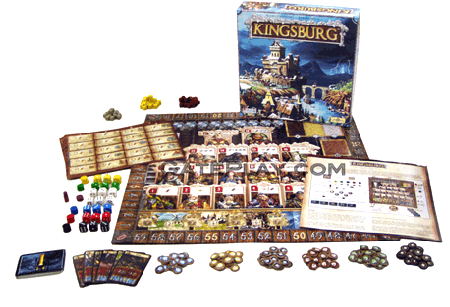
Kingsburg

Worker Placement Games: Kingsburg
Worker placement is a very common mechanic in euro-style games.  It basically means "players each have a limited number of dudes to place on a limited number of board spaces to get stuff."  These games can get really complex, and I tend to avoid the heaviest ones where you have to go through about 5 steps before actually scoring points.  Kingsburg, however, greatly simplifies this process and adds the excitement of rolling dice, which are basically your "workers."  Based on what you roll, you place your dice on different "advisor" spaces which gets you things like building materials and soldiers for your army.  Then you get points by building structures and fighting off the baddies that attack the kingdom at the end of every year.  It requires a careful but accessible balance of short-term reactions ("here is what I rolled...crap he took the spot I wanted") and long-term strategic planning ('I want to work towards building the cathedral").  Other worker placement games I've enjoyed include Alien Frontiers (which also uses dice), Stone Age, and Tribune.

Flash Point: Fire Rescue

Cooperative Games: Flash Point: Fire Rescue
Many non-gamers are probably unaware there exists an entire genre of board games that require the players to work together to defeat the game.  Great co-op games instill a great sense of camaraderie and tension as players try to achieve a seemingly impossible goal.  (Good co-ops are also hard, as they would get old quickly if the players always won.)  Pandemic and its simpler cousin Forbidden Island tend to be the poster children for intro co-ops, but I'm going to pick the lesser known Flash Point as my recommendation.  As you might expect, in this game players are a team of firefighters trying to rescue victims from a burning building.  You can do things like chop down walls, drive the truck and ambulance, and fire the deck gun.  It requires a great amount of planning and communication among the players.  Best of all, the rules are incredibly adjustable, which allows for a very easy game that kids can play or a brain-buster that any gamer can get into.  Once you've cut your teeth on these pure cooperative games, you can graduate to Shadows Over Camelot, which adds the possibility of a secret traitor in the players' midst.

Small World

Area Control Games: Small World
What's an area control game?  Just think of Risk.  You score points by having pieces in certain areas of the board, and usually take over new areas by fighting other players' pieces.  Most war games are such.  Small World, though, is what I call a "euro war" game, in that it is heavily influenced by other European board games and features diceless, deterministic combat.  Players pick a race such as Halfings, Orcs, Humans, or Dwarves, which also has some special ability paired with it.  They then use the tokens of that race to take over as many areas of the board as possible, and can defeat other players simply by overwhelming them with more tokens.  Eventually, though, that race will be overextended, and you'll have to put them in decline and start over with a new race (the decision of when to do this is the most important you'll make in the game).  The random pairing of races and special abilities in every game really adds to the replayability, and the simplicity of the combat rules makes it very accessible.  Along with economic games, area control games are my favorite genre, which is why I'm going to highlight one more...

El Grande

Bonus!  El Grande - The Next Step in Area Control
El Grande is my #2 overall favorite game.  It was the first great Euro-style area control game, and is still arguably the best.  If you want to split hairs, El Grande is technically an "area majority" game, because you score points simply by having the most pieces in an area, rather than kicking other players out.  You try to score as many points as possible by placing pieces in different areas of Spain and trying to have more pieces in each area (you also score points for placing 2nd and 3rd).  There are devious ways to mess with other players' pieces, and a tower you can place hidden pieces in to be distributed on the board later.  Gamesmanship is very high in this one, and the elegance with which is plays out renders it one of the all-time greats.  It's not a gateway game, but if you can play Risk, you can play El Grande.  In my humble opinion, it sits at the pinnacle of board game design.